

Two years ago I ordered a HurryCane because I was tired of the cane I already owned. Not tired of using a cane, exactly. I have relapsing-remitting MS, and on my good days a cane is the difference between a walk around the block with Penny and no walk at all. I was tired of a cane that slid off the back of a chair, got left in the car, and could not fold up small enough to fit in my bag. The HurryCane Freedom Edition promised a cane that folded, stood on its own, and hooked over a chair without falling. I have used it nearly every good day since. This is the long-term report, because the first week with any cane is easy. The second year is the real test.
I should say plainly what this review is not. It is not a claim that a cane changed my MS, because nothing has. It is not medical advice, and I am not a physical therapist. It is one retired librarian in Fort Collins, Colorado, telling you what a folding cane did and did not do over two years of grocery trips, library visits, dog walks, and one very long day at the Denver Zoo with our three grandkids.
The Quick Verdict
The HurryCane is the best folding cane I have owned, and the only one that has survived a full year in my bag. It is not the lightest, not the cheapest, and the grip needs a break-in period. But it stands on its own, folds small, and has never once let me down on a good day.
Amazon Check Today's Price →If you only ever buy one folding cane, make it this one
After two years of daily use, the HurryCane Freedom Edition is still the cane I reach for first. It folds small enough for my bag, stands on its own, and hooks over a chair without sliding off. Check today's price on Amazon and see if it fits your routine.
Amazon Check Today's Price on Amazon →How I've Used It
My routine has not changed much since I got it. On a good day, I walk Penny around the block twice, once in the morning and once after lunch. That is about a mile and a half total, on flat sidewalks with one small hill. I use the HurryCane on my right side, because my left leg is the weak one, and I lean on it more than I should. On medium days, when the fatigue is worse but I still want out of the house, I take it to the grocery store and hang it over the cart handle. On bad days, I use my rollator, and the HurryCane stays folded in the car.
The cane has also gone with me to the library where I used to work, to two grandchildren's school concerts, to a wedding, and to the Denver Zoo. It has been rained on, baked in a hot car, and dropped on concrete more times than I can count. It has survived all of it. That is the part no one tells you about mobility gear: the real test is not the first week, it is the 700th time you fold it, unfold it, and trust it not to collapse.
The zoo trip last October is the day I remember when people ask if the cane earns its place. Rob and I took all three grandkids, and we were on our feet for six hours. The HurryCane folded into my crossbody bag on the tram, came out for the walk between exhibits, and stood on its own beside the bench while I ate lunch. By late afternoon my left leg was done, and Rob pushed me out in the transport chair we keep in the CR-V. But for the hours I could walk, the cane did exactly what it was supposed to do.
One thing I did not expect: the HurryCane changed how I carry things. Because it folds small, it lives in my crossbody bag when I am not using it. That means I never have the moment, familiar to every cane user, of realizing I left the cane in the car and now have to walk back for it. The cane is with me because it is already in the bag.
What Makes the HurryCane Different
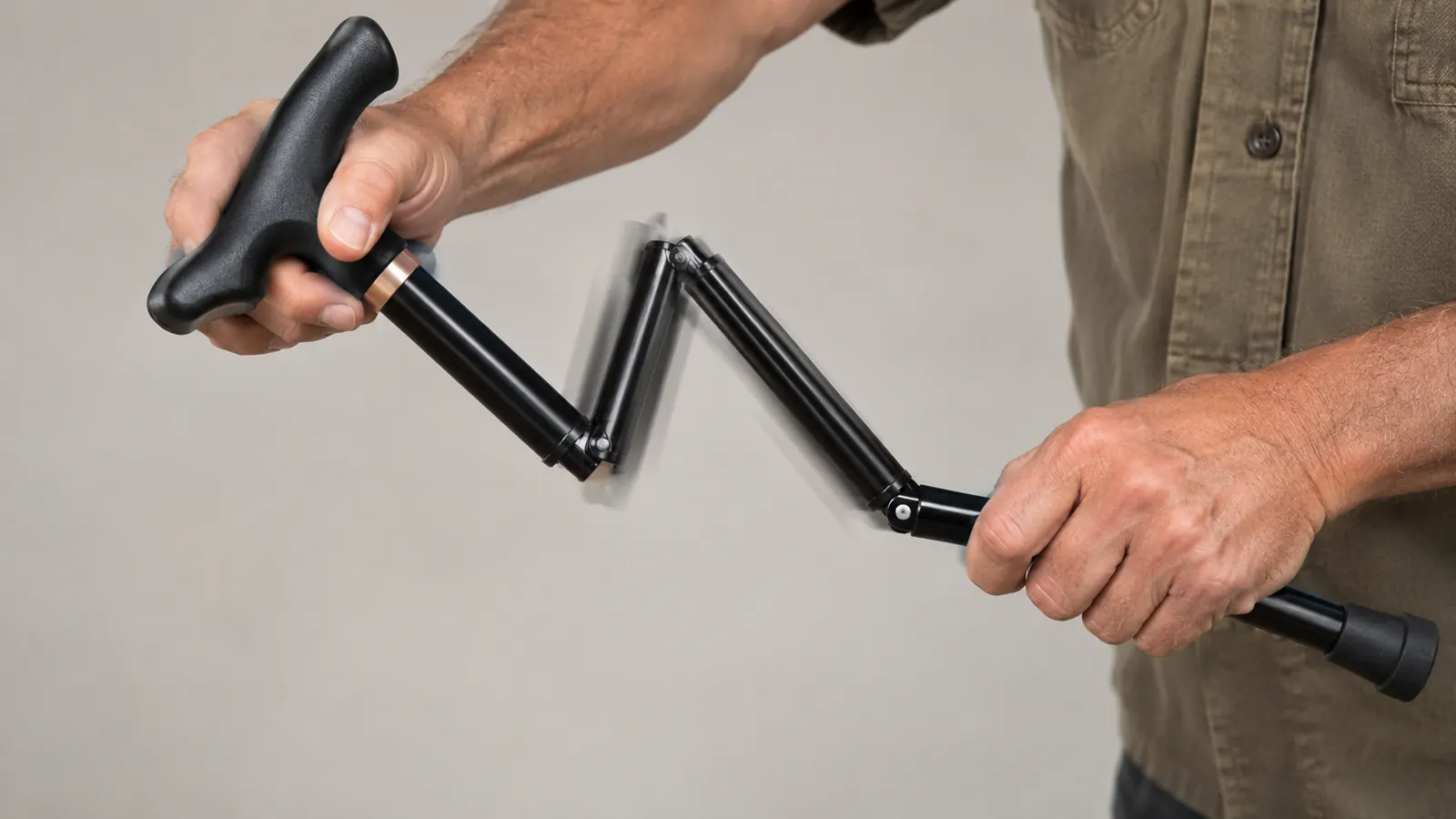
The HurryCane Freedom Edition is a folding cane with a T handle, and the folding is the whole story. It breaks into four sections that snap together with a button on each joint. When it is folded, it is short enough to fit in a tote bag, which is the feature that sold me. My old cane did not fold, and it spent most of its life propped against walls where it could fall over. The HurryCane folds down to about the length of a large umbrella, and it comes with a small carrying pouch.
The other feature I use constantly is the base. The bottom of the cane has a flat foot, wider than a standard cane tip, so the cane stands up on its own when you set it down. That sounds minor until you have tried to pick up a cane from the floor of a public restroom. I set the HurryCane down at my feet in the checkout line, and it is still standing there when I reach for it. My old cane would have rolled or fallen within seconds.
The T handle is the part I was most skeptical about. I had always used a curved crook cane, the kind that hooks over your forearm. The T handle on the HurryCane is wider and flatter, and it took me about two weeks to stop gripping it too tightly. Once I relaxed, I found it gave me a more stable platform to push down on. The grip is padded, which matters on days when my hands are tired. On long outings I still wish the grip were a little softer, but it has not caused blisters or sore spots.
I should also tell you what I tried before this one, because it explains my skepticism. A few years earlier I bought a cheap folding cane from the drugstore, the kind with a cord running through the middle. It folded, but the sections never lined up quite right, and it had a wobble at the joint that I did not trust on the two steps up to our front door. I carried it for three weeks and then stopped, because a cane I do not trust is worse than no cane at all. The HurryCane joints are the opposite. Each section snaps in with a positive click, and two years later that click is still there.
How It Held Up Over Two Years
I am going to tell you the honest wear report, because this is the part reviews usually skip. After two years of nearly daily use, the HurryCane looks used. The shaft has small scratches from being dropped on concrete. The padding on the grip has compressed slightly where my hand always rests. The folding joints have not loosened. The buttons still snap firmly. Nothing has wobbled, and the cane has never once collapsed under me.
The one thing that did wear out was the carrying pouch. The zipper pull broke off after about a year. The pouch still closes, but I have to pinch the zipper. That is a small thing, and it did not affect the cane itself, but I mention it because I am the person who wants to know before I buy.
I also want to be honest about the weight. The HurryCane is not the lightest cane I have held. It is heavier than a standard aluminum cane because of the folding joints and the wider base. For me, that extra weight is a fair trade for the stability. But if you have very weak wrists or severe arthritis in your hands, you should try holding one before you buy. My friend Ellen, who has rheumatoid arthritis, tried mine and found it too heavy for daily use. She uses a lighter cane instead.
The rubber foot is the only part I have replaced, and I learned that lesson the hard way. The original lasted about sixteen months before the edge wore unevenly from the way I set the cane down. I replaced it with a standard rounded tip from the hardware store, and the cane rolled over twice in the first week, because the flat base is what makes it stand on its own. I ordered the HurryCane replacement foot, and it snapped on in about a minute. My advice: buy the right foot, not the cheap one.
What I Liked
- Folds small enough to live in my crossbody bag, so it is always with me
- Flat foot means it stands on its own; no more fishing it off restroom floors
- Padded T handle gives a stable platform to push down on
- Folding joints have not loosened after two years of daily use
- Hooks over chair backs and cart handles without sliding off
Where It Falls Short
- Heavier than a one-piece aluminum cane; my friend with arthritis found it too heavy
- Grip is firm, not plush; it took me two weeks to stop gripping too tightly
- Carrying pouch zipper pull broke after about a year
- Not enough support for bad days; I still reach for my rollator
- Replacement foot must be the HurryCane part, not a standard rounded tip
Two years in, the folding joints still snap firmly, the cane has never collapsed under me, and the only thing that wore out was a zipper pull on the pouch.

The Good Days and the Bad Days
With MS, my needs change day to day, and the HurryCane fits my good days better than my bad ones. On a good day, when my left leg is cooperating and my balance is okay, the HurryCane is exactly right. It gives me enough support to walk a mile, it folds when I sit down, and it stands up when I set it down. On a medium day, it is still useful, but I lean on it harder and I can feel the extra weight in my shoulder by the end of an outing. On a bad day, I do not use it at all. I use my rollator, because a cane is not enough support when my leg is not listening.
That is not a flaw in the cane. It is the reality of a progressive condition, and it is why I get annoyed by reviews that promise a cane will give you your life back. A cane is a tool. The HurryCane is a very good tool for the days when a cane is the right tool. It does not replace a rollator, a transport chair, or a conversation with your physical therapist about what your body needs.
Heat is the other variable. On a cool morning in May, I can do the full loop with Penny and barely lean on the cane. On a 90-degree afternoon in July, the same loop leaves me gripping the handle hard and stopping twice to rest. The cane did not cause that, and no cane can fix it. But the extra weight of the folding joints feels different on a heat-fatigue day. What feels like a fair trade on a good day can feel heavy on a bad one.
Who This Is For
Buy the HurryCane if you are a person who uses a cane part of the time and needs it to be portable. It is ideal for people who are on their feet for short stretches, sit down often, and need a cane that does not fall over or get left behind. It is also a strong choice if you are buying a cane for someone else and want one that folds small enough to keep in a car or a bag. The T handle makes it easier to push down on, which helps people who need to take weight off a weak leg, like I do with my left leg.
I also think it is a good cane for travel. It folds small, it stands on its own, and it does not look like medical equipment. If you are going to an airport, a wedding, or a long day at the zoo, the HurryCane folds into your bag when you do not need it and comes out when you do. That is the whole reason I bought it, and it has never disappointed me on that front.
Who Should Skip It
Skip the HurryCane if you need a cane for full-time, heavy support. The folding joints add weight, and if you are putting your full weight on a cane for every step, a rigid one-piece cane is lighter and simpler. Skip it if you have very weak hands or significant arthritis in your grip, because the T handle still requires you to hold on, and the extra weight will tire you faster. My friend Ellen is the example I keep coming back to: she loved the idea, but her hands made the decision for her.
Skip it if you need a quad cane, a seat cane, or any cane with a specific medical feature. The HurryCane is a folding support cane, and it does not try to be anything else. And if your balance is bad enough that a cane is not enough, talk to your physical therapist about a rollator or a walker. I have both, and I use both. The HurryCane is one tool in the toolbox, not the whole toolbox.
The cane that still earns its spot in my bag, two years later
If you are looking for a folding cane that stands on its own and folds small enough to carry, the HurryCane Freedom Edition is the one I keep coming back to. It is not perfect, and I have told you exactly where it falls short. Check today's price on Amazon and decide if it fits your good days.
Amazon Check Today's Price on Amazon →