

I bought my Drive Medical rollator on a Tuesday in April, the same week my physical therapist told me to stop pushing through the fatigue. I am Joanna Whitcombe, 58, a retired middle-school librarian in Fort Collins, Colorado, and I have lived with relapsing-remitting MS for 14 years. My left leg is the weak one, and heat makes everything worse. On good days I use a cane. On longer outings I use a rollator. This is the one I have used for the better part of a year, and this is what it is actually like.
Most rollator reviews you will find are written by people who used the thing for a weekend and then moved on. I have rolled mine through grocery aisles, along the Poudre Trail, through two airport terminals, and up and down the two steps to my front door more times than I can count. It has been rained on, hauled in and out of our 2019 Honda CR-V, and used as a seat while I waited for my husband Rob to bring the car around. I have strong opinions about it, and a few complaints, and I am going to share both.
The Quick Verdict
A light, sturdy rollator with a genuinely useful seat. It does not climb steps and it fights thick carpet, but for everyday errands it has earned its place in my house.
Amazon Check Today's Price →The rollator I reach for on every errand
After ten months of daily use, this is the one I keep coming back to. Check today's price on Amazon and see whether it fits your setup.
Amazon Check Today's Price on Amazon →How I've Used It
I use this rollator most days, but not every day. On a good day, a cane is enough for the trip from the car to the library. On a medium day, the rollator comes with me to the grocery store. On a bad day, Rob pushes the transport chair and the rollator stays home. This is a tool with a job, and I have learned exactly what that job is.
Most of my use falls into three buckets. First, errands: the grocery store, the pharmacy, the post office. Second, exercise: my dog Penny, a 24-pound beagle mix, walks beside me on the Poudre Trail every morning, and the rollator keeps me steady while she sniffs every third bush. Third, waiting: I use the seat whenever I have to stand too long, which is the part I did not expect to love.
The walker folds flat enough to fit in the back of our CR-V without complaint. Rob lifts it in and out, but I can manage it myself when I need to. The braking handles took me about a week to learn, and I still squeeze them a little too hard when I am tired. That is a me problem, not a rollator problem.
Most mornings look the same. I wake up, Penny does her little stretch, and we head out before the heat builds. The rollator waits by the front door, folded. I unfold it, set the height without thinking, and we walk the loop around the block. Some days the loop is easy. Some days I sit on the seat halfway through and let Penny sniff the grass until my leg stops shaking. The rollator makes both days possible, and that is the whole point.
The Frame and the Wheels
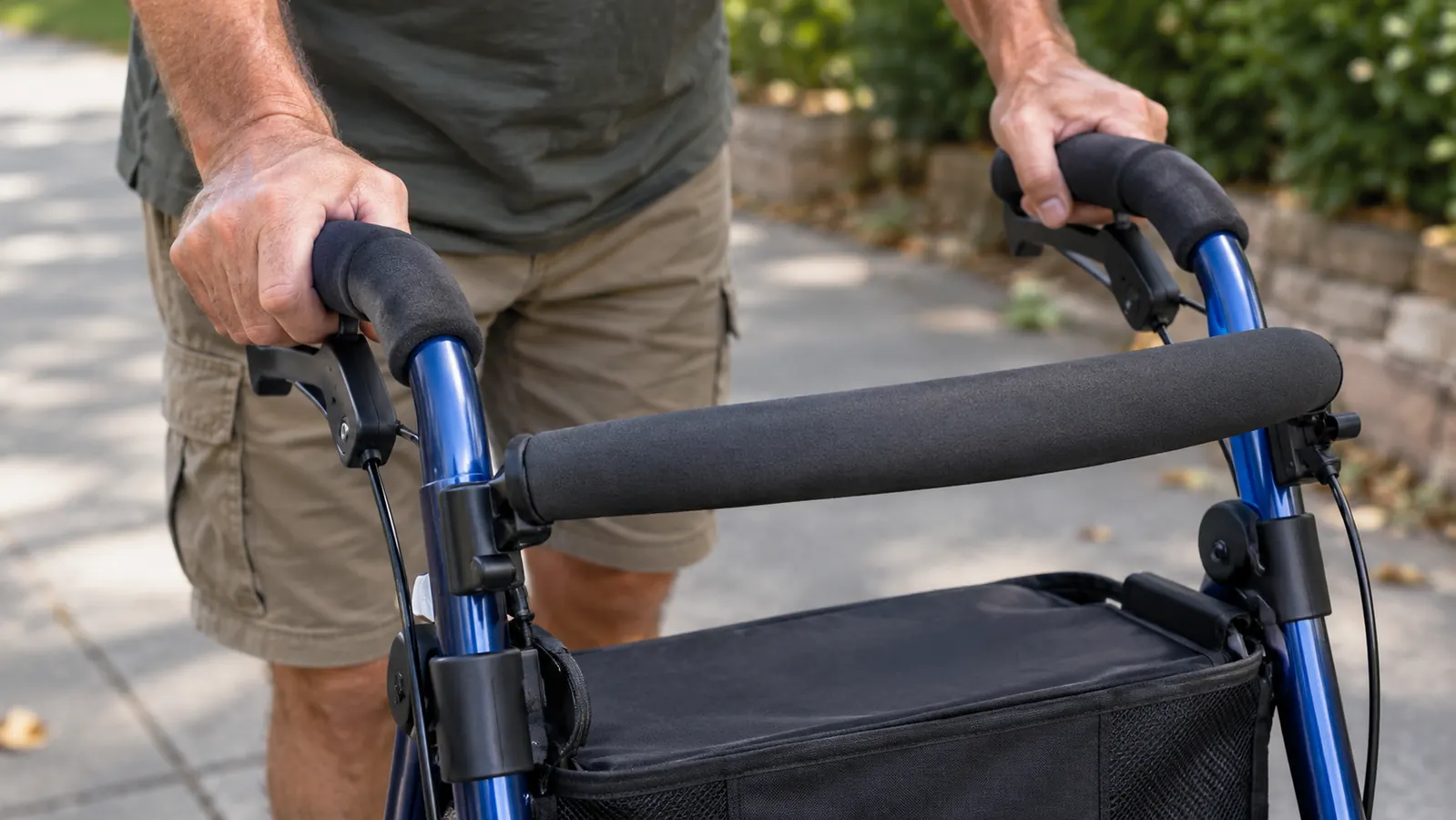
The aluminum frame is light enough that I can lift the front end over a curb without bracing myself, and the 6-inch wheels handle the cracked sidewalks in my neighborhood better than I expected. The front wheels swivel, which makes steering feel almost natural, though it took me a few days to stop overcorrecting.
The hand grips are foam, and after an hour of pushing they are comfortable. My hands do not go numb the way they did with the standard walker I borrowed from a neighbor after knee surgery in 2021. The height adjusts with a simple push-button mechanism, and I set it so my elbows sit at about a 90-degree angle, the way my physical therapist showed me.
That is the part of this product that matters most for someone with MS: it does not add to your fatigue. It rolls smoothly on flat ground, so I am not constantly fighting it. On carpet it is a different story, and I will get to that.
Turning around in a narrow aisle is where the swivel wheels earn their keep. I can rotate in place, which I could not do with the borrowed walker. The base is wide enough to feel stable when I lean on it, but not so wide that I bump doorframes. That balance is harder to design than it looks, and Drive Medical got it right.
The Seat: The Feature I Underestimated
I did not buy this rollator for the seat. I bought it because it folds and has wheels. The seat turned out to be the reason I reach for it.
MS fatigue does not announce itself politely. One minute I am fine, and the next minute my left leg is done, and I need to sit down before I fall down. With this rollator, I can sit anywhere, anytime, without hunting for a bench. I have sat on it in the produce aisle, at the dog park, and in the middle of the Poudre Trail while Penny waited patiently.
The padded seat is firm enough to be stable and comfortable enough for a ten-minute rest. The weight limit is generous, and at my size I never worry about it. The only catch is that the seat is not a chair. You sit upright with your feet on the ground, which is exactly what you want when your legs need a break.
There is also a storage pouch under the seat, which I almost forgot to mention. It is not huge, but it holds a purse, a water bottle, and a small bag of dog treats. When I am at the farmers market, I can pile a loaf of bread and a quart of peaches into it and still push with both hands on the grips. That sounds small, but it is the difference between a solo errand and asking Rob to come along.
What Slows It Down
I have three honest complaints, and I want to be straight about them because they will matter more to some people than to me.
First, the brakes. The rollator uses squeeze handles that press on the rear wheels. They work, and they work reliably, but they took practice. The first week I grabbed them too hard and the rollator stopped so abruptly I almost pitched forward. You learn the feather touch, but you do learn it.
Second, carpet. On low-pile carpet the wheels roll fine. On thick carpet, or on a rug with a pad underneath, this thing is a sled that does not want to move. I have learned to lift the front wheels over the edge of our living room rug, and it is not a big deal, but it is a real limitation.
Third, the two steps. My house has two steps up to the front door, and this rollator does not climb them. I have a routine: I fold it, hand it to Rob, and use the railing. If I lived alone, I would need a different solution, and that is something to know before you buy.
How It Held Up Over Months
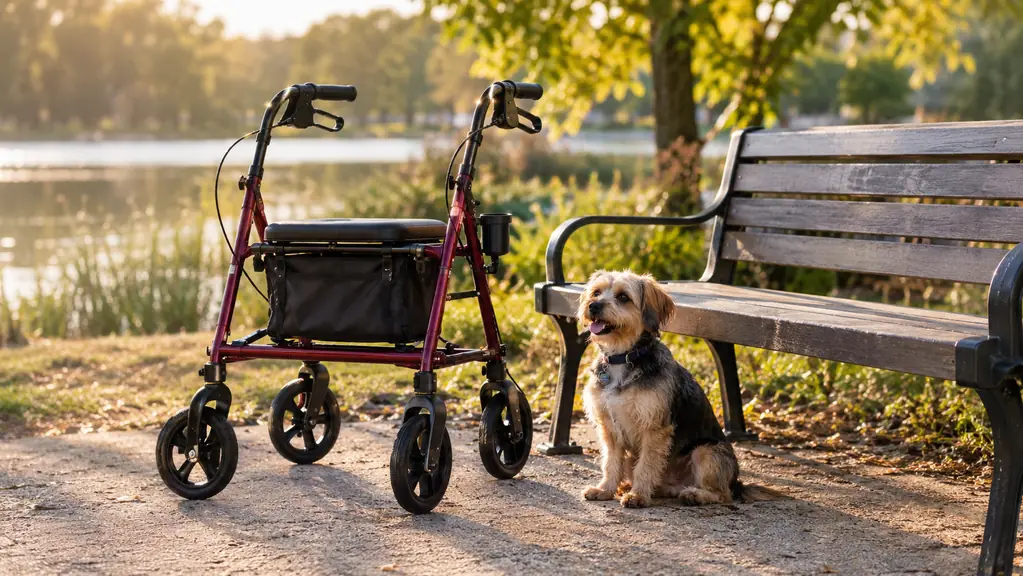
I have owned this Drive Medical rollator for about ten months. The frame has no rust, even after being caught in a rainstorm on the trail. The wheels show normal wear. The foam grips have compressed slightly but not cracked. The folding mechanism still clicks into place the way it did on day one.
The only thing that has needed attention is the brake cables. Around month six, the left brake started to feel loose, and I tightened the adjustment screw with a small wrench. It took me ten minutes and a video call with my son-in-law, who is handy. That is maintenance, not a defect, but it is worth knowing.
The seat shows a little wear where I sit, which is cosmetic. The frame does not show dirt the way I expected it to, which I appreciate, because I am not always graceful with it. I will not describe it as beautiful, because it is medical equipment, but it is not ugly either.
Cleaning is easy, which matters more than you might think. The frame wipes down with a damp cloth, and the seat does too. After a rainy walk I just dry the grips and leave it folded by the door. There is no fabric to unzip and wash, and nothing that has rusted or corroded in ten months.
Alternatives I Considered
Before I bought the Drive Medical, I looked at three other options. The first was a standard walker, the kind without wheels that you lift with every step. It is cheaper and lighter, but it has no seat, and it does not let me carry a bag of groceries. The second was a transport chair, which is what Rob pushes when I have a big day out. It is the right tool for airports and the zoo with our grandkids, but it needs a second person, and I wanted something I could use on my own. The third was a rollator with larger wheels, which rolls better on trails but does not fold as small and costs more.
I chose the Drive Medical because it hit the balance I needed: light enough to lift, sturdy enough to lean on, with a seat for the bad moments. It is not the fanciest rollator on the market, and it is not the most expensive. It is the one that works for my specific version of a very common problem.
If you are new to rollators, here is what I would tell you: rent or borrow one before you buy, if you can. Try it on the exact floors in your house, and take it to your exact grocery store. A rollator that works in a showroom can feel completely different in your hallway. That advice has nothing to do with this specific product and everything to do with buying mobility gear well.
What I Liked
- Light aluminum frame I can lift over curbs and into the car myself
- Padded seat turns any stop into a rest break when fatigue hits
- Folds flat enough for the back of our Honda CR-V
- 6-inch wheels handle sidewalks and trail gravel better than I expected
- Height adjusts with a simple push-button mechanism
- Brakes work reliably once you learn the feather touch
Where It Falls Short
- Squeeze brakes take practice and grab hard if you squeeze too much
- Thick carpet and rugs turn it into a sled
- Does not climb steps; I need Rob for the two steps to my front door
- Brake cables needed a small adjustment around month six
I have sat on this seat in the produce aisle, at the dog park, and in the middle of the Poudre Trail while Penny waited patiently. That is what a rollator seat is for.
Who This Is For
This rollator is for people who can walk some but not always, and who need a place to sit when the walking stops. It is for the person who is tired of asking a spouse or a friend to slow down, and for the person who wants to carry their own groceries. It is for someone like me: a person with a condition that comes and goes, who needs a tool that comes and goes with it.
If that sounds like you, and you have a way to manage the steps into your house, this is a genuinely good rollator. It is the one I reach for every morning when Penny and I head out the door.
It is also for the family members who shop for someone else. My daughter bought my first rollator, and she did it blind, without knowing what to look for. If that is you, look for three things: a frame you can lift, a seat you can trust, and brakes you can reach. This rollator has all three.
Who Should Skip It
Skip this rollator if you need to carry it up stairs on your own, because it is light but not weightless. Skip it if you spend most of your time on thick carpet, because the wheels will fight you. Skip it if you need something that folds into a bag for air travel, because it folds flat but it is not compact.
And if your balance is unsteady even when you are standing still, talk to your physical therapist about whether a rollator is the right tool at all. It is a walking aid, not a fix for every mobility problem. That is the honest version, and it is the one I wish someone had given me before my first purchase.
One more group should skip it: people who need to use a rollator on grass or gravel every day. The 6-inch wheels are fine for packed trail dirt, but soft ground will bog them down. For that use, a rollator with larger wheels is worth the extra money, and I would not want you to buy this one and be disappointed.
The rollator that has carried me through ten months of errands
If you are weighing a rollator for yourself or for someone you love, this is the one I would buy again. Check today's price on Amazon and decide with your own numbers in front of you.
Amazon Check Today's Price on Amazon →