

I keep both in my coat closet. The standard walker has been there since my physical therapist suggested it three years ago, and the Drive Medical rollator arrived last spring when I realized I was avoiding every errand that required carrying a cup of coffee. I have relapsing-remitting MS, diagnosed fourteen years ago. Most days my left leg is just tired. Some days it forgets to hold me. If you are trying to decide which one belongs in your house, I can tell you what fourteen years of bad days taught me: they are not the same tool, and the right answer depends on which of your days you are shopping for.
The short version: if you need something to lean on while you shuffle across the bedroom at night, a standard walker is lighter and easier to store. If you need to walk a mile at the farmers market with a bottle of water in one hand and stop to rest before the walk back, the Drive Medical rollator wins by a lot. I use the rollator for almost everything now. But I have not thrown the walker away, and I will explain why.
How I Tested Both
I tested them the way I actually live, not the way a product lab would. For two weeks I used the standard walker for every trip longer than the length of my hallway, then I switched to the rollator for the same errands. I walked Penny in the morning, went to the grocery store, stood in line at the post office, and made one trip to the garden center where the aisles are gravel. I also kept the walker by the bed at night, because that is where a standard walker earns its keep. I am not a physical therapist, so I checked in with mine before I started. If your balance is unsteady even when standing still, do the same before you buy anything.
A note on my setup: I am 58, I live in a single-story ranch in Fort Collins, and my MS mainly shows up as fatigue and left-leg weakness. Heat makes it worse, so summer mornings are my good hours. Penny, our seven-year-old beagle mix, walks slowly beside whichever aid I am using, and she is the reason I get outside at all. Rob lifts the folding transport chair into the back of our CR-V for big days out. These details matter because the right mobility aid is the one that fits your actual floor plan, your actual errands, and your actual bad days.
| Drive Medical Rollator | Standard Walker | |
|---|---|---|
| Best day for it | Long outings, uneven sidewalks, carrying things, stopping to rest | Short indoor trips, middle-of-the-night bathroom runs, tight spaces |
| Weight | About 18 pounds, feels heavier when lifting into a car | Usually under 7 pounds, easy to lift one-handed |
| Stability when standing still | Four wheels and locking brakes, steady on flat ground | Four points on the floor, very stable, no brakes to fail |
| Rolling on uneven ground | Bigger wheels roll over cracks, gravel, and grass | Small wheels catch on any bump, front wheels wander |
| Seat | Padded seat lets you rest anywhere, plus a storage pouch | No seat, you must keep standing or find a chair |
| Carrying things | One hand stays on the handlebar, the pouch holds small items | Both hands needed for balance, nothing to carry |
| Storage at home | Folds flat but takes up more room and weighs more | Folds thin, hangs on a hook, lives behind a door |
| Best for | MS days when you want to get out of the house | MS nights when you just need to reach the bathroom |
Where the Drive Medical Rollator Wins
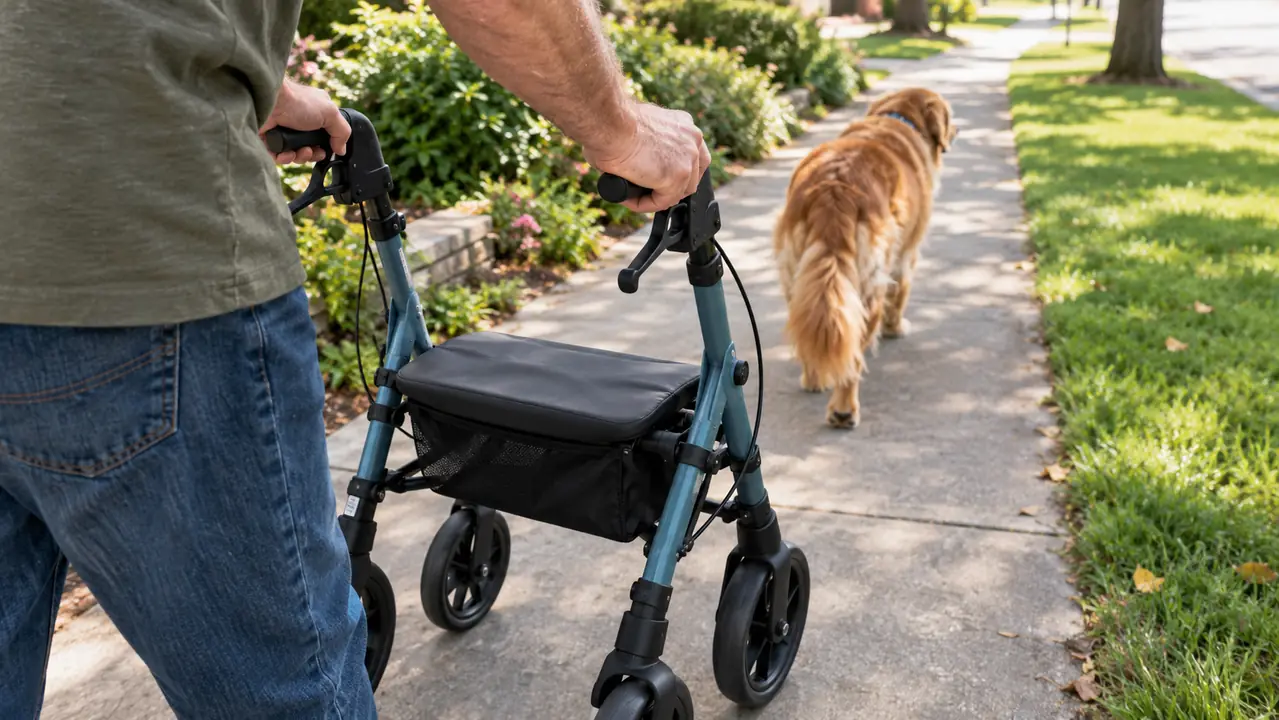
The first time I took the Drive Medical rollator to the farmers market, I walked further than I had in a year. The difference is the wheels. The rear wheels are larger than the front ones, and all four roll over the cracks in the sidewalk instead of catching in them. My standard walker has two small front wheels and two glide tips, and every expansion joint on the path feels like a speed bump. With the rollator I stop worrying about the ground and start paying attention to the tomatoes.
The seat is the other half of the win. On a bad day, knowing I can sit down anywhere changes the math of leaving the house. I have sat on the rollator seat at the dog park, in the checkout line at the hardware store, and once on the path around the reservoir while Penny decided a squirrel was worth investigating. The storage pouch under the seat holds my phone, a water bottle, and a small umbrella. I cannot do any of that with the standard walker. When I use it, I am standing until I get back to the car, and on an MS day that is a gamble I do not like.
The brakes took me a week to trust. They are the squeeze-lever kind, and they lock the rear wheels when you push down. The first few times I sat on the seat, I was convinced the whole thing would roll out from under me, so I only sat when the brakes were locked. Now I use them without thinking. If you buy a rollator, practice the brake-and-sit motion at home a few times before you need it in public. It is a skill, and it takes about an afternoon to learn.
Where the Standard Walker Wins
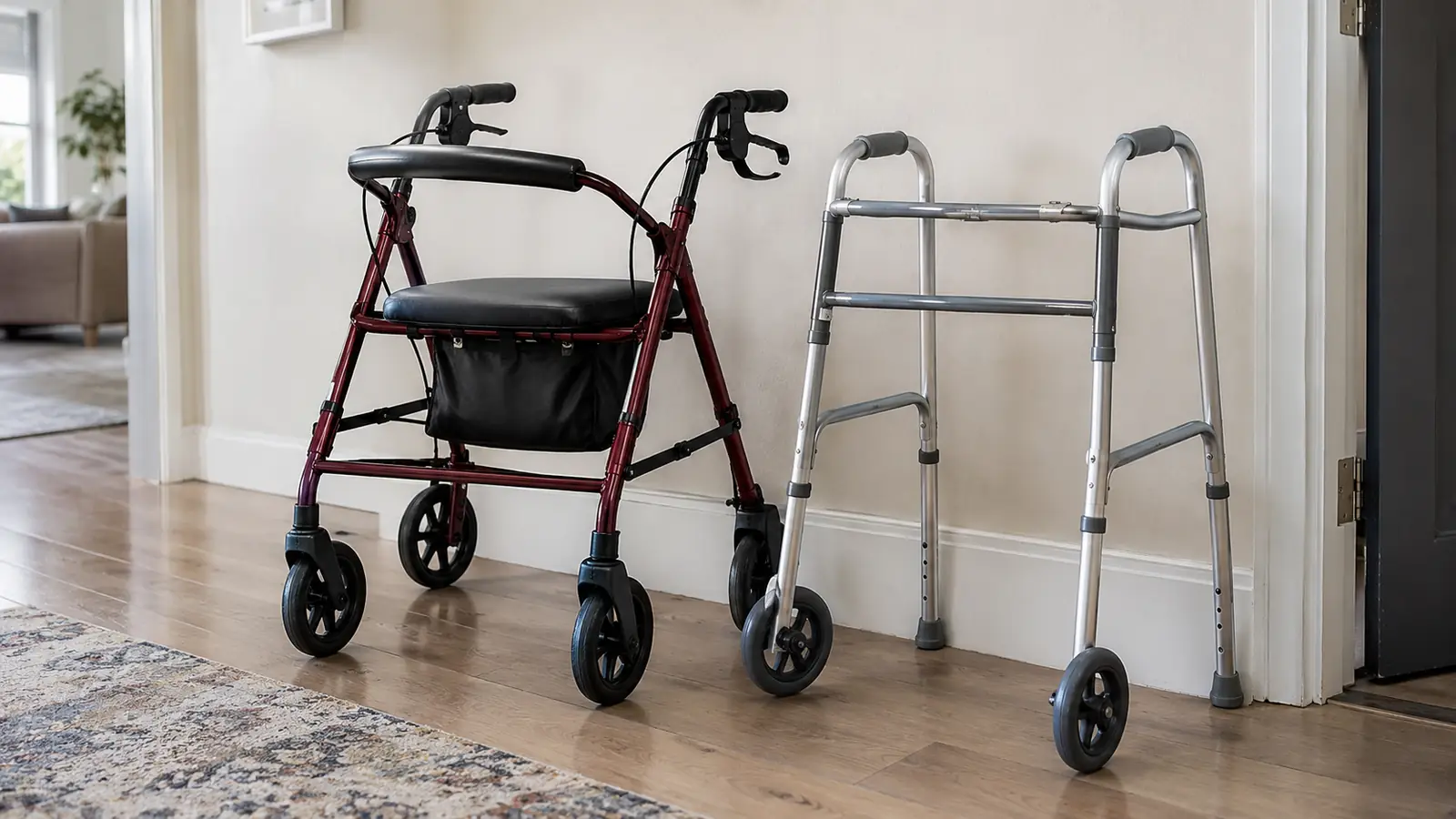
I am not going to pretend the standard walker is inferior, because at 2 AM it is the better tool. When I get up to use the bathroom, I do not want eighteen pounds of rollator to unfold and steer. I want the walker that lives beside my bed, weighs almost nothing, and gives me four solid points of contact with the floor. Its glide tips do not roll away from me on the hardwood, and I can push it ahead of me one-handed while I steady myself against the wall with the other.
It is also the honest answer for tight spaces. My hallway is narrow, and the standard walker turns around in it without drama. The rollator can do it, but it takes a three-point turn and a little patience. And when Rob and I travel, the walker folds flat enough to slide behind the passenger seat of our Honda CR-V. The rollator folds too, but it is heavier and bulkier, and lifting it into the car is a two-person job on a tired day. So the walker stays in the rotation, not because it is better, but because it is better for specific hours of the day.
The other thing the walker has going for it is simplicity. There are no brakes to fail, no seat latch to check, no pouch to zip. If my hands are cold or my brain is foggy, I can grab it and go. On days when my fatigue is bad, the last thing I want is a piece of equipment that asks me to think. The walker does not ask anything of me. That is a real feature, even if it does not appear on the box.
The rollator that got me back to the farmers market
Four wheels, a padded seat, and a pouch for the things you actually carry. If your bad days are keeping you indoors, this is the one I reach for.
Amazon Check Today's Price on Amazon →The rollator got me back to the farmers market. The walker still gets me to the bathroom at 2 AM. I need both, and I bet you will too.
What Nobody Tells You About Switching
The first thing nobody tells you is that your arms get stronger. With the standard walker, I leaned on it and my shoulders did most of the work. With the rollator, I push it, and pushing uses different muscles. After a month, carrying a grocery bag felt easier. My physical therapist said that makes sense, because the rollator keeps me more upright and my legs do more of the work. That was a surprise, and a pleasant one.
The second thing is that the rollator changes how strangers see you, and I was not prepared for how much I would care. With the walker, people offered to help me constantly. With the rollator, I look like someone who is out for a walk, and people mostly leave me alone. That sounds small, but it changed how I felt about going to the post office alone. I will not pretend it is true for everyone, because it is not, but it was true for me.
The third thing is maintenance. The rollator has moving parts, and moving parts need attention. I check the brakes monthly, wipe the wheels when I bring it in from gravel, and tighten the screws on the handles twice a year. The standard walker has needed nothing in three years. That is not a reason to avoid the rollator, but it is a reason to buy from a brand that sells replacement parts. Drive Medical publishes the manual online, and that matters more than you would think.
The fourth thing is that you will probably use the rollator more than you expected and the walker less, or the other way around, and either way is fine. There is no prize for using the expensive one. Some weeks I use the rollator every day and the walker sits untouched. Then I get a cold, my balance gets worse for a few days, and the walker comes back out. Let your body set the schedule. That is the whole philosophy of living with a progressive condition: you adapt, and the equipment should adapt with you.
Who Should Buy Which
Buy the Drive Medical rollator if you want to leave the house. If your goal is a walk around the block, a slow lap at the zoo with your grandkids, or an hour at a museum where you will need to sit down mid-visit, the seat and the wheels are worth every pound. Buy it if you are tired of asking your spouse to carry your water bottle. Buy it if you have ever stood at the end of a store aisle and wondered whether you could make it back to the car, because the seat turns that question off.
Buy the standard walker if your main need is inside the house. If you are recovering from surgery and the hallway to the bathroom is the longest distance you cover, the lighter frame is easier and safer. If you live in a small apartment with no place to store a folded rollator, the walker wins on space. And if your balance is unsteady even when standing still, the four fixed points of the walker give you a more stable base than wheels ever will. Ask your physical therapist which base suits your balance, because that is a safety question, not a preference question.
One more honest note: I have seen people use a rollator as a transport chair, leaning back into the seat while someone pushes. Do not do that. The rollator is not built for it, and the instructions say so. If you need a chair for big days out, that is a separate piece of equipment, and Rob and I keep a folding transport chair in the CR-V for exactly that reason.
The Bottom Line
If I could only keep one, I would keep the Drive Medical rollator, because it is the one that gets me out of the house. But I would not have said that before I owned both. The standard walker taught me what I needed from a mobility aid, and the rollator showed me what was possible. That is the honest order of things.
Here is how I think about it now: the walker is my indoor tool and the rollator is my outdoor tool, and my life needs both. If you are shopping for yourself or for a parent, do not let anyone tell you there is one right answer. There is only the answer that fits your floor plan, your balance, your errands, and your worst hour of the day. Ask your physical therapist, try both if you can, and buy the one that makes tomorrow morning feel possible.
Still deciding? Start with the one that gets you out the door
The Drive Medical rollator is the reason I walk Penny every morning instead of watching her from the window. Check the current price and see if it fits your days.
Amazon Check Today's Price on Amazon →