
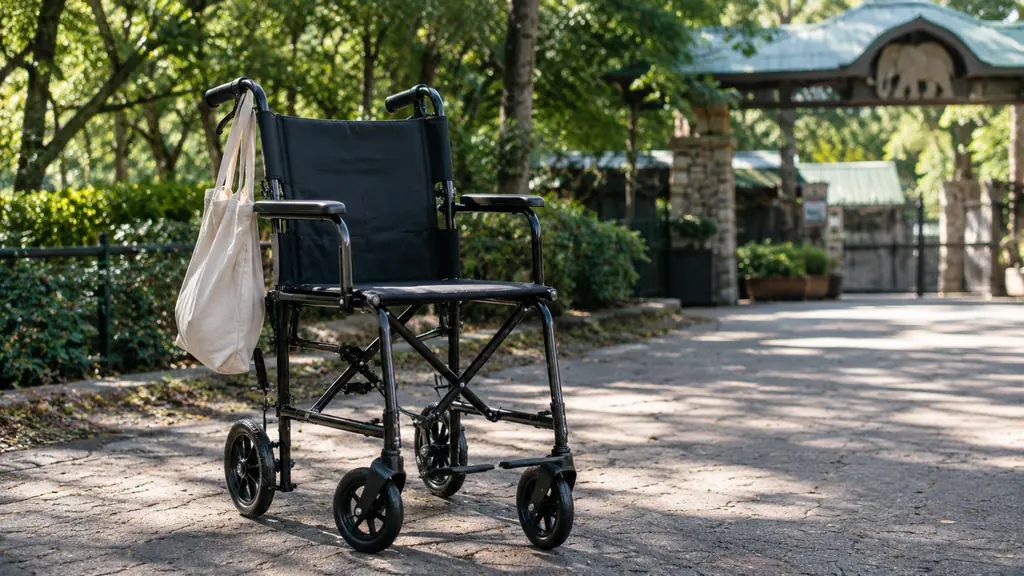
The day I finally admitted I needed a transport chair was not the day I fell. It was the day I stood at the far end of the Denver zoo with my granddaughter asking why Grammy could not walk to the sea lion pool. I had the cane, I had the rollator, and I had about 400 yards left in my legs. My husband Rob looked at me, I looked at him, and neither of us said the thing we were both thinking. We had already rented a Medline transport chair at an airport the year before, and it had turned a four-hour layover into something close to a normal day. So we bought one. Eighteen months later, this is the long-term review I wish I had read before I ordered it.
This is not a review of whether a transport chair cures anything. It does not. I have relapsing-remitting MS, diagnosed 14 years ago, and my left leg and my energy reserves are what they are. This is a review of a specific piece of equipment that makes big days out possible, used in real conditions: airports, zoos, a grandson's graduation, a museum, a crowded farmers market, and one very long day at a wedding in a venue with no elevator.
The Quick Verdict
The Medline transport chair is the best big-day tool we own: light enough for Rob to lift, simple enough for me to trust, and sturdy enough that I stopped checking the wheels after the first month. It is not a wheelchair for everyday independence, and it will not fix a bad day. It exists to make a good day longer, and it does that job better than anything else we have tried.
Amazon Check Today's Price →The chair that turned our zoo trips from 40 minutes into 4 hours
If you are the person who plans the outing, you already know the math: a transport chair does not add distance to your legs, it adds time to your day. Check today's price on Amazon and see if it fits your budget.
Amazon Check Today's Price on Amazon →How I've Used It
I have used this Medline chair at least twice a month for 18 months. That is roughly 40 outings, and I kept a small notebook for the first six months because I knew I would forget the details. The pattern that emerged is consistent: I walk when I can and ride when I cannot, and the chair is always there for the second half of the day.
A typical big day looks like this. We park, I walk from the car to the entrance with my cane, and Rob pushes the chair, which he has already unfolded and set by the trunk. I sit down when my hip starts to ache or when I can feel the heat pulling the energy out of my legs. We trade off: twenty minutes walking, twenty minutes riding. At the end of the day I am tired but not wrecked, and the difference between that and a day without the chair is the difference between a good memory and a week of recovery.
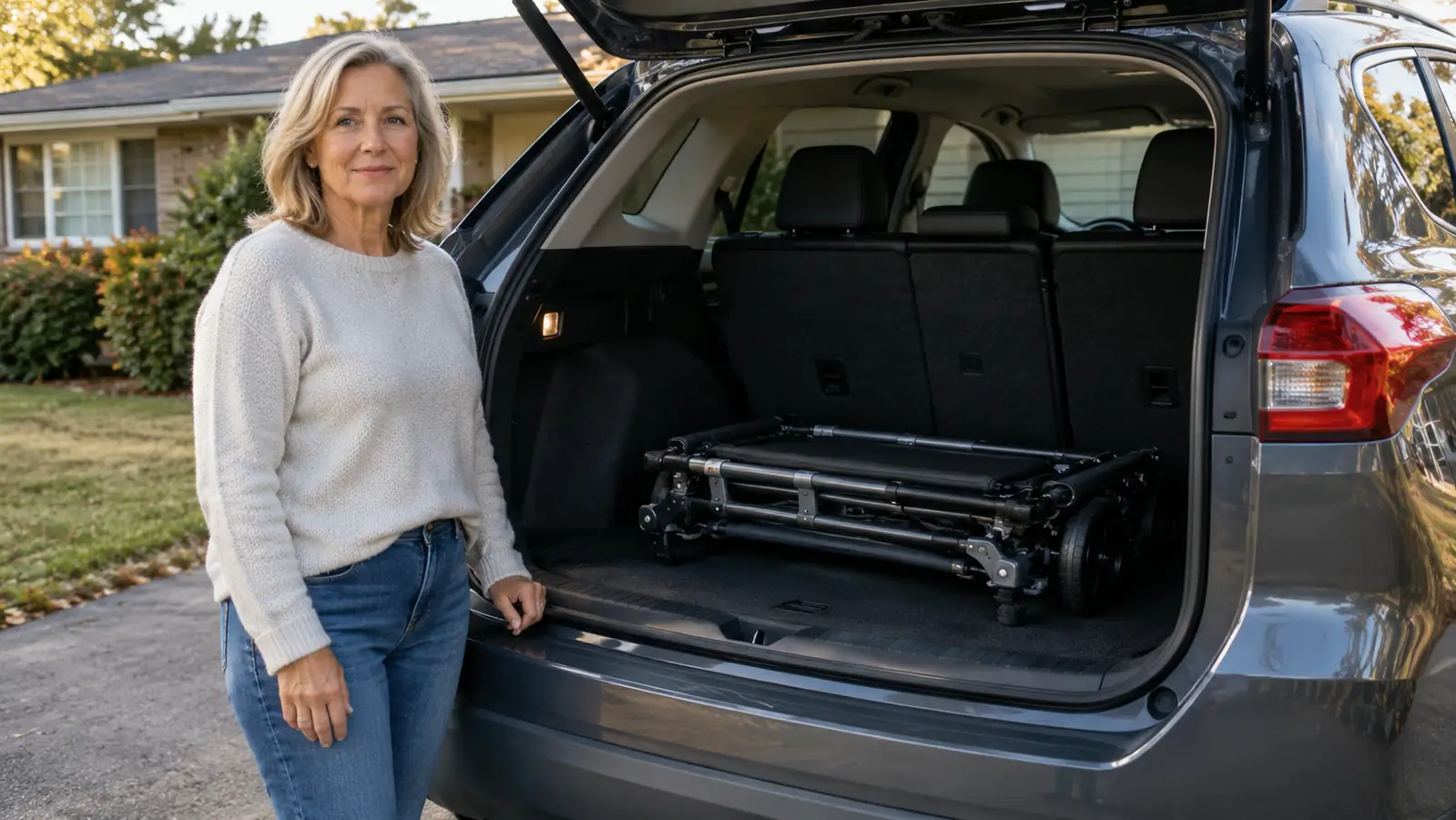
I have also used it on days I did not plan for: a sudden rainstorm at an outdoor market, a long security line at the airport, and one evening when my left leg simply stopped cooperating halfway through a family dinner. The planned days are where it earns its place, though. The clearest example was our grandson's graduation in May. The overflow lot was a half mile from the arena, and I knew before we parked that my legs would not do the round trip. I walked the first quarter mile with my cane, rode the second, and walked into the ceremony on my own two feet. I stayed for the whole thing, including the long wait while the graduates filed past, and I did not spend the next day in bed. That is what a big-day chair is for: it does not make the day easy, it makes the day possible. The chair lives folded in the back of our 2019 Honda CR-V, and that is the detail that matters most. It is there before I need it, which is the only time a mobility aid is actually useful.

What the Chair Actually Is
The Medline is a transport chair, not a standard wheelchair. The difference matters. It has smaller 12-inch rear wheels, no push rims on the wheels, and it is designed to be pushed by someone else. I cannot self-propel it for any real distance, and I do not try. What I can do is sit in it comfortably for hours, be pushed through a crowd without bumping anyone, and stand up from it without a struggle. Those three things are the whole job, and it does all three well.
The frame is aluminum, and the whole thing folds with a pull on the seat. Rob, who is not a strong man, lifts it into the back of the CR-V without thinking about it. The seat is a sling style, which sounds like it would be uncomfortable and is not: I have sat in it for four straight hours at an airport and the only complaint I had was that I should have brought a small cushion, which I now keep in the bag that hangs from the handle.
The handbrakes are the feature I did not expect to care about. They are on the push handles, so Rob can slow the chair on a downhill slope without reaching down to the wheels. The museum ramp is the test I come back to. It is a long concrete slope, maybe 60 feet, and before we owned the chair I would not have attempted it at all. With the brake, Rob can hold the chair perfectly still on that slope, which means I can get in and out without the chair rolling away from me. The brake handles are also where his hands rest naturally, so slowing down does not interrupt the push. That one feature has turned several buildings with awkward entrances from places I dread into places I can manage. I have used the brakes more in 18 months than I have used the footrests, and I use the footrests a lot.
How It Holds Up Over Time
The honest answer is: better than I expected, with a few specific exceptions. The frame shows no wear at all after 18 months. The folding mechanism still clicks into place the same way it did on day one. The wheels roll smoothly, and I have not had a single flat or a single wobble. The county fair in August was the roughest test. The main path is packed gravel with a few soft patches, and I was sure the small wheels would pick up stones and jam. They did not. A few pebbles got caught in the tread and fell out on their own. The only maintenance I have done in 18 months is wiping the frame down after a dusty day and checking that the latch still clicks shut. The latch is the part I watch, because a folding chair that folds itself open in the back of a car would be a problem, and after a year and a half it has never once done that. For a piece of equipment that gets folded, thrown into a car, unfolded, and pushed over pavement, gravel, and the occasional curb cut, that is a good record.
The upholstery is the weak point. The seat fabric is fine, but the armrest pads are thin and the stitching on one of them started to fray around month nine. It is cosmetic, not structural, and it has not gotten worse. The footrests are also the part I would change if I could: they are functional but narrow, and my feet slide off them when I am wearing shoes with smooth soles. I have learned to keep my feet planted, but I should not have to think about it.
The other long-term note is the bag. There is no storage on the chair itself, so we bought a simple cloth bag that hangs from one of the push handles. It holds my water bottle, a snack, a small cushion, and my phone. It swings a little when Rob pushes fast, but it has never fallen off, and it means I do not have to hold anything in my lap. If you buy this chair, buy a handle bag on the same day. You will want it by the second outing.
How It Compares to My Rollator
People ask me why I do not just use my rollator for everything, and the answer is that they are different tools. My rollator is for independence: I walk behind it, I lean on it, I stop when I want to look at something. It gives me freedom. The Medline chair gives me endurance. It is for the moment when the freedom runs out, and that moment always comes on a big day.
The rollator also cannot carry me when I am too tired to stand. The transport chair can, and that is not a small thing. On a good day I might use the rollator for the whole outing and never sit in the chair. On a long day I use both, and the chair is what lets me stay for the second half. If you can only afford one, buy the rollator first. If you already have the rollator and you are still skipping events, this chair is the missing piece.
The chair is there before I need it, which is the only time a mobility aid is actually useful.
What It's Like to Ride In It
The thing nobody tells you about being pushed in a transport chair is that the experience is mostly about the person pushing. A good push is smooth, a bad push is jarring, and the Medline does what it can to make a good push easy. The handles are at a comfortable height for Rob, and he says the chair tracks straight without constant correction. That matters more than it sounds: a chair that wanders makes the pusher tired, and a tired pusher makes for a short outing.
For me, the ride is comfortable but not luxurious. The seat is firm, the back is upright, and there is no headrest, which I do not miss because I do not nap in it. The footrests fold up when I stand, which is convenient, and the armrests flip up, which makes getting in and out much easier than I expected. I can transfer from the chair to a restaurant chair or a car seat without help, and that independence is the reason I reach for this chair instead of staying home.
The one ride complaint I have is curbs. This is not a chair designed for off-road use, and I do not use it off-road. The worst ride I have had was on the brick path at the farmers market. The small wheels found every seam, and I felt every one of them in my lower back. Rob slowed down and we moved to the street, which was smoother, and the rest of the morning was fine. The brick path taught me to check for the paved alternative before we leave the house, and now I do. It was not the chair's fault. It was my route planning, and that is a fixable problem. A standard curb cut is fine. A curb without a cut requires Rob to tip the chair back, and while he has done it safely many times, it is not something I enjoy. If your daily life involves a lot of curbs without cuts, you will want to plan your routes or consider a different chair. For us, it is a minor issue on maybe one outing in five.
The Pros and Cons
What I Liked
- Light enough for one person to lift and fold without strain
- Folds flat enough to live in the back of a compact SUV
- Handbrakes on the push handles make downhill slopes manageable
- Flip-up armrests and folding footrests make transfers easy
- Sling seat is genuinely comfortable for hours at a time
- Simple, sturdy design that has held up well through 18 months of regular use
Where It Falls Short
- No built-in storage, so you need to buy a handle bag separately
- Armrest padding is thin and the stitching started to fray around month nine
- Footrests are narrow and my feet slide off in smooth-soled shoes
- Not self-propelling, so you depend on someone else to push
- Small 12-inch wheels mean you feel every bump on rough pavement
Who This Is For
This chair is for the person who has a rollator, uses it well, and still hits a wall on big days. It is for the person who plans a zoo trip and knows the second half of the day will be a problem. It is for the family member who wants to say yes to the wedding, the graduation, the long airport layover, and wants a tool that makes the yes believable. If you can walk some but not all of the way, and you have someone willing to push, the Medline transport chair is the difference between attending and participating.
It is also for the person who needs to be able to get out of the chair independently. The flip-up armrests and folding footrests make that possible for me, and I am not a small woman or a particularly strong one. If your physical therapist has cleared you for transfer with minimal assistance, this chair will not fight you.
Who Should Skip It
Skip it if you need a chair you can push yourself. The Medline is a transport chair with 12-inch wheels and no push rims, and self-propelling it for more than a few feet is exhausting. If independence on wheels is the goal, look at a standard wheelchair with larger wheels and push rims, and ask your physical therapist which one fits your upper body strength.
Skip it if your days are mostly indoors at home. A transport chair is a big-day tool, not a house chair. For moving around a single-story home, a rollator or a walker is usually the better tool, and the chair will just take up space. And skip it if you are the only adult in the house and you need to be pushed regularly: this chair needs a pusher, and no amount of clever design changes that.
One chair, 18 months, and a lot of good days
The Medline transport chair is not a cure-all and it will not pretend to be. It is a sturdy, simple tool that has made my big days longer and my recovery days shorter. If that sounds like the trade you are looking for, check today's price on Amazon.
Amazon Check Today's Price on Amazon →