

On the Tuesday after Thanksgiving last year, I tried to take a bath while Rob was out running errands. I got in fine, using the grab bar we had installed when we remodeled the bathroom in 2022. Getting out was the problem. My left leg, the one MS has weakened over the past fourteen years, would not take my weight, and I ended up on my knees on the bath mat, gripping the edge of the tub, waiting for the garage door to open. Rob found me there, embarrassed and cold, and neither of us said much about it that night. The next morning I called my physical therapist and told her I needed something. She suggested I look at a shower chair, and she was specific about what to look for: a seat at the right height, armrests I could push against, and a back so I could rest. Rob, who does the grocery shopping with me, came home from a different errand with a different idea: a tub transfer bench. So I tested both, in my own bathroom, over six weeks in January and February. The short answer: the Medline Shower Chair with Padded Armrests and Back is the one I kept, and the transfer bench went back. But the honest answer is that the right choice depends on your tub, your balance, and how much help you have on the days you need it.
Here is the part nobody tells you before you start shopping: a shower chair and a transfer bench solve different problems, and the catalogs do not explain the difference. A shower chair sits inside the tub or shower and you step into it. A transfer bench straddles the tub wall, so you sit down outside the tub, then slide across into the water. If you cannot lift your leg over the tub wall at all, the bench wins before the chair gets a vote. If you can step in but not stand for long, the chair wins. I can do a small step with my cane on a good day. On a bad day, I cannot. That is why I needed both, and why I am glad I tested both before spending money on the wrong one. I also learned that the right choice changes as your body changes. What worked for me in January might not be what I need in July, when the heat makes my fatigue worse. So I tested both the way I test everything now: one week with each, then a week of switching back and forth, with a notebook on the bathroom counter to write down what annoyed me.
| Medline Shower Chair | Tub Transfer Bench | |
|---|---|---|
| Getting in | Step over the tub wall, then sit | Sit outside the tub, then slide across |
| Getting out | Stand, then step out | Slide back to the outside edge, then stand |
| Fits a walk-in shower | Yes, sits anywhere on the floor | No, needs a tub wall to straddle |
| Fits a tub with a wall | Yes, sits inside the tub | Yes, straddles the wall |
| Weight capacity | 350 lb capacity, stated by the manufacturer | Usually 300 to 400 lb, check the model |
| Stability on the floor | Four feet on the tub floor, very stable | Two feet in the tub, two on the floor, can shift if the wall is uneven |
| Best for | People who can step in but not stand long | People who cannot lift a leg over the tub wall |
Where the Medline Shower Chair Wins
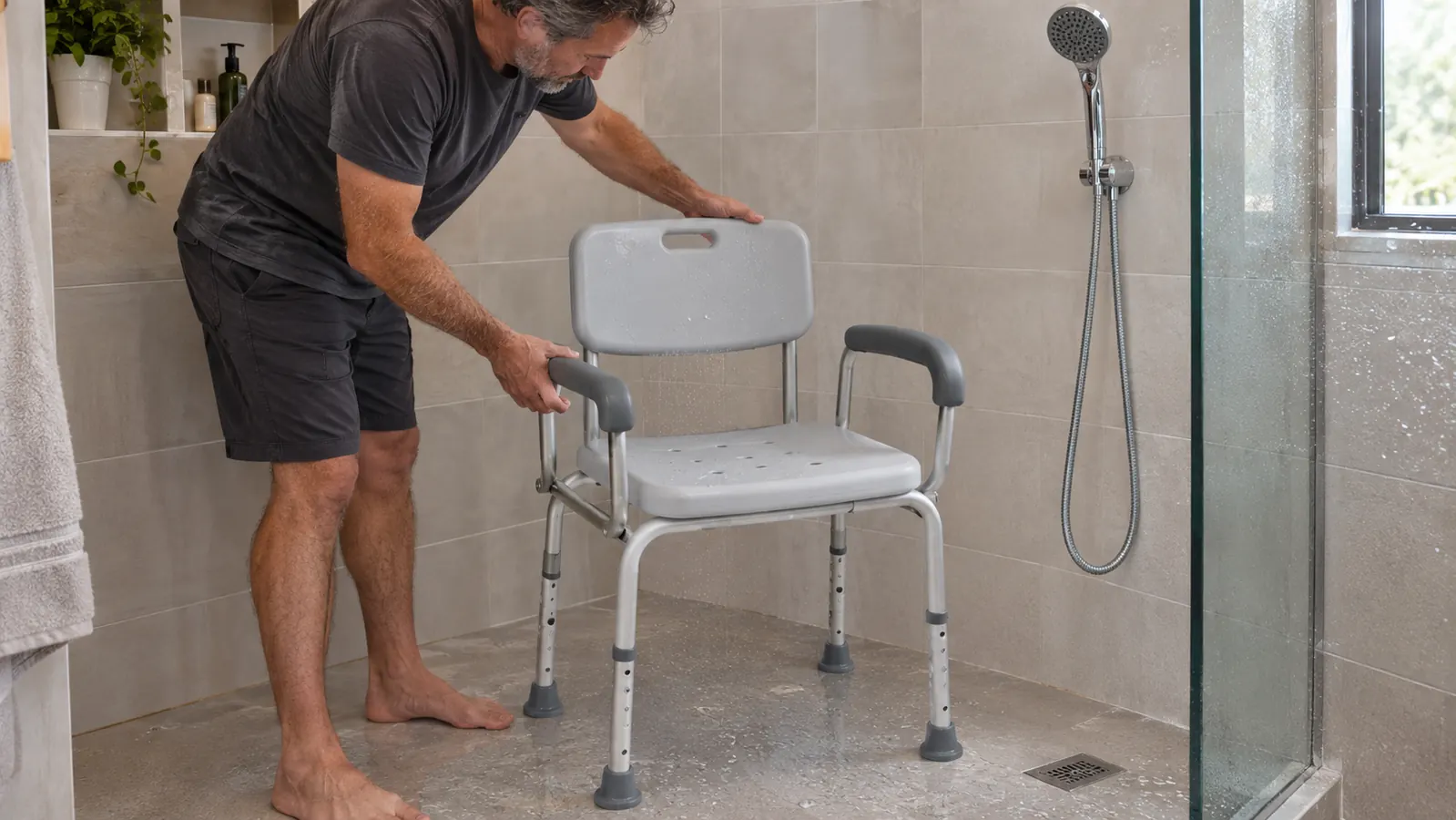
The Medline Shower Chair with Padded Armrests and Back won me over for one simple reason: it does not care what kind of bathroom you have. I have a walk-in shower that was remodeled in 2022, and the chair sits on the flat floor like it was made for it. No straddling, no measuring, no worrying about whether the tub wall is level. The four feet grip the floor, the padded armrests give me something to push against when I stand, and the back means I can lean back and just breathe for a minute. On a bad day, that back is the difference between a shower and an ordeal. The first time I used it, I planned a five-minute shower and ended up sitting under the warm water for fifteen, just letting my legs rest. The chair does not wobble when I shift my weight, and the feet have not slid on the tile once, even with soapy water on the floor. I also like that it is not bolted to anything. I can move it out of the way when Rob cleans the shower, and I can take it with us when we visit our daughter in Denver, because it folds down flat enough to go in the back of the Honda CR-V. Rob lifts it in, and it takes up less room than the rollator.
The other thing the Medline chair does better is feel like furniture instead of medical equipment. The padded seat is comfortable enough that I have sat on it fully dressed, just to tie my shoes. The height adjusts in one-inch increments, and the legs have clear markings, so I set it to the same height as my rollator seat. That means I can transfer from the rollator to the chair without thinking about it, which matters more than it sounds. A transfer you have to think about is a transfer where you can hesitate, and hesitation on a wet floor is how falls happen. My physical therapist watched me do it and said that is exactly the transfer we want you to practice. That is the highest praise I can give a piece of bathroom gear. The one thing I would change is the footrest, which is a separate piece that I keep knocking with my toe. I do not use it, because my feet are flat on the floor at this seat height, and it lives propped against the wall most days. I mention it because the product photos make it look essential, and I have not missed it.
Where the Tub Transfer Bench Wins
I have to be fair to the transfer bench, because for a lot of people it is the right answer. The whole point of a bench is that you never have to lift your leg over the tub wall. You sit down on the outside half, scoot across the seat until you are over the water, and then lower yourself in. For someone who has had hip surgery, for someone whose leg simply will not lift, or for someone who lives alone and cannot risk a fall, that is a genuine advantage. My neighbor Carol, who is 81 and had a knee replacement in January, uses a transfer bench and swears by it. She told me she has not taken a bath in three years because she was afraid, and now she takes one every week. She also told me the first time she used it, she sat on the outside edge for ten minutes before she worked up the nerve to slide across. The bench did not rush her. That patience is the real benefit, and no product description will tell you about it. I watched her use it one Sunday afternoon, and what struck me was how calm she looked. Her feet were planted on the bath mat, both hands were free, and she took her time. That is the whole argument for a bench in one image. If your balance is such that you cannot sit down without holding something, a bench is worth a serious look even if you only have a tub.
The bench also wins on the getting-out problem. Getting out of a tub is statistically more dangerous than getting in, because you are wet, the floor is slick, and your muscles are tired. With a bench, you slide back to the outside edge, plant both feet on the bath mat, and stand up with your weight over solid ground. That is a real safety feature, not a marketing one. I returned my bench not because it was bad, but because my tub has a curved lip that made the bench rock slightly every time I shifted my weight, and because I have a walk-in shower that the chair fits better. The rocking was not the bench's fault. It was the tub's fault, and measuring the wall before buying would have told me that. If I still had a standard tub with a flat rim, I would own the bench and I would be glad of it. I would also buy a separate nonslip bath mat for the outside foot, because the one we have slides on the linoleum, and I learned that the hard way the first week. The bench itself went back in the original box, and the return was easy, but the lesson about measuring stayed with me.
The transfer bench wins the hardest part of the problem: you never have to lift your leg over the tub wall. The Medline chair wins everything else about actually being in the water.
The chair that made my shower feel like a shower again
The Medline Shower Chair with Padded Armrests and Back is the one I kept. It fits my walk-in shower, holds my weight without wobbling, and the padded back means I can sit down and rest mid-shower instead of rushing. If you can step into your tub or shower, this is the safer, simpler choice.
Amazon Check Today's Price on Amazon →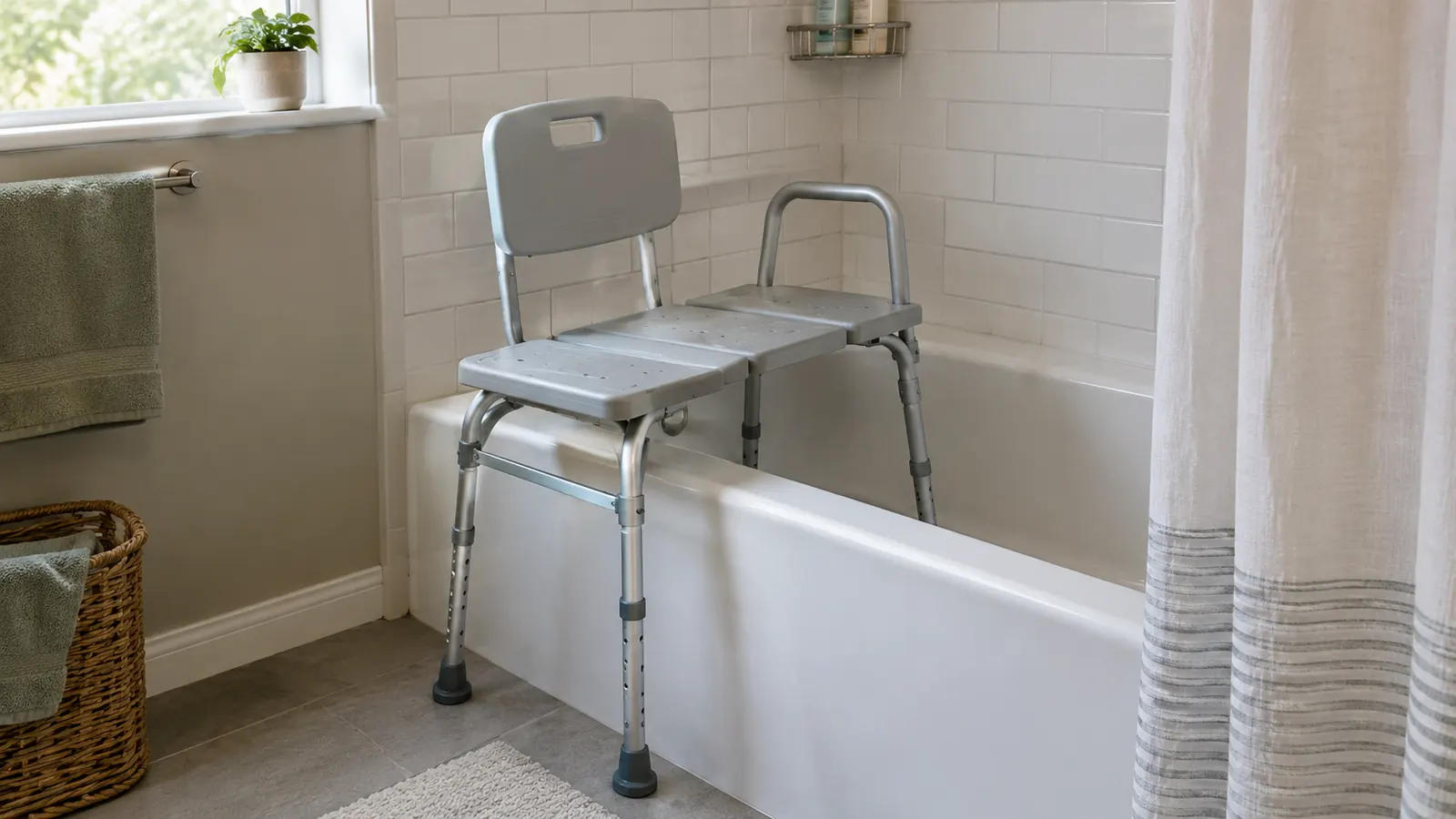
Who Should Buy Which
Buy the Medline Shower Chair if you can step into your tub or shower, even with a cane or a hand on the wall, but you cannot stand for the whole shower. That is me on most days. The chair gives you a place to sit, a back to lean on, and armrests to push off from. It also works in a walk-in shower, which a transfer bench cannot do. If you have a stall shower, the decision is already made: the Medline chair is the one that fits. My rule of thumb after six weeks is simple. If the step is the problem, buy the bench. If standing is the problem, buy the chair. Most of us with MS, arthritis, or recovery after surgery have a standing problem more often than a stepping problem, which is why the chair is the more versatile choice for most people.
Buy a tub transfer bench if your problem is the step, not the standing. If you cannot lift your leg over the tub wall at all, if you have had hip or knee surgery, or if you are the one helping a parent bathe and you need them to sit down on solid ground first, the bench is the safer tool. It is also the better choice if you live alone and want to minimize the time you spend standing on wet tile. The tradeoff is that it only works with a tub, and it needs a reasonably flat tub rim to sit level. Carol's tub has a flat rim and her bench has not moved an inch in the two months she has owned it. Mine has a curved lip and the bench rocked. Same product category, two different results, all because of the tub. So measure the rim before you order, and if the rim is curved, look for a bench with adjustable feet or skip the bench entirely. A bench that rocks even a little is not a bench you will use, and an unused safety device is just furniture.
One more thing I learned the hard way: measure your tub before you buy either one. The Medline chair is 20.5 inches wide and fits a standard tub, but if your tub is narrow, check the width. My guest bathroom tub is six inches narrower than the main one, and the chair would not have fit in there at all. The bench needs to span the tub wall, so measure the wall thickness and the tub depth, and write the numbers down before you open the product page. And whatever you choose, ask your physical therapist to watch you use it once. The right equipment, set up wrong, is just a different kind of hazard. I set my chair height wrong the first week, one notch too low, and my knee complained for two days. The fix took thirty seconds, once I knew what to look for. That is a mistake you can skip, and I would rather you skip it than learn it the way I did.
My bathroom, six weeks later: one chair, zero falls
I kept the Medline Shower Chair with Padded Armrests and Back and I use it every single day. It is stable, comfortable, and it made me stop avoiding showers. If you can step into your tub, this is the chair I would buy again. Check the current price on Amazon and read the recent reviews before you decide.
Amazon Check Today's Price on Amazon →