

The first cane I bought for my weak left leg was too tall. I knew it the second I put weight on it. My shoulder crept up toward my ear, my elbow locked straight, and by the end of the block my arm ached worse than my leg. I had picked it by holding it next to my hip, which is what a well-meaning relative told me to do, and it was exactly the wrong method for me.
Here is the plain truth about canes: the height and the grip decide whether the thing helps you or slowly makes you miserable. A cane that fits lets you walk farther with less effort. A cane that does not fit throws off your posture, tires your shoulder, and can make you less steady, not more. That is why I want to walk you through how I fit a cane now, step by step, using the HurryCane Freedom Edition I have been testing for the past few months.
Get the height right before you worry about anything else
The HurryCane Freedom Edition adjusts from about 30 to 37 inches, which covers most adults between roughly 5'1" and 6'3". If you are in that range, you can fit it to your wrist crease in about two minutes. Check today's price on Amazon.
Amazon Check Today's Price on Amazon →Step 1: Measure from the floor to your wrist crease
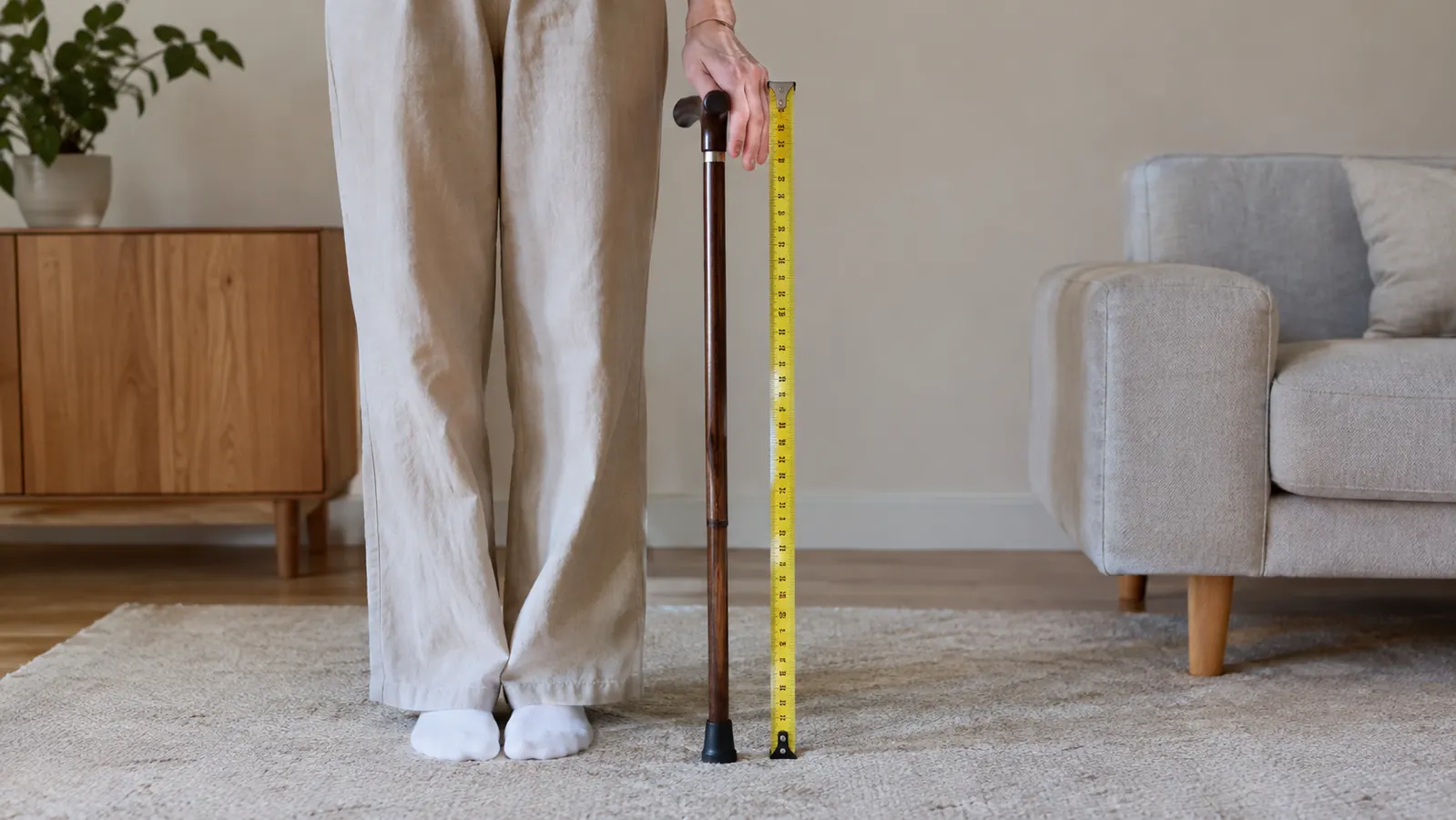
Put on the shoes you will actually wear when you walk. Stand as tall as you comfortably can, let your arms hang naturally at your sides, and have someone measure from the floor straight up to the crease on the underside of your wrist. That number, in inches, is your cane height. For me that is 31 inches. It is the same method my physical therapist used when I asked her to check my fit, and it is the one I trust. My first cane measured 33 inches at the floor, which sounds like a small difference. Two inches changed everything: my elbow locked straight, my shoulder crept up, and after a half mile around my neighborhood in Fort Collins I had a headache from tensing my neck. I did the wrist crease measurement with Rob one evening in March, wrote down 31 inches, and the same walk felt like a different activity.
Do not use the hip method. It sounds sensible and it is everywhere, but it tends to give you a cane that is too tall, which is exactly the mistake I made the first time. The hip method is what put my old cane two inches too tall. I lived with that cane for six months because I assumed the problem was me. It was not me. It was the geometry. If you do not have someone to help you measure, stand against a wall, hold a small object like a paperback book under your arm at your side, and mark where the bottom of the book lands. That mark is close to your wrist crease.
When your cane is the right height, your elbow should bend about 15 to 20 degrees when you grip the handle and stand tall. That slight bend lets your arm act as a shock absorber. If your elbow is locked straight, the cane is too tall. If your elbow bends sharply, it is too short. I check this in a mirror every time I adjust a cane for myself or for a friend. With the HurryCane, I set it to 31 inches and the bend looked right on the first try. With my old cane, no amount of fiddling could fix the angle, because the shaft itself was simply too long. You cannot adjust your way out of a height that is wrong at the start.
Step 2: Decide which grip your hand can actually hold
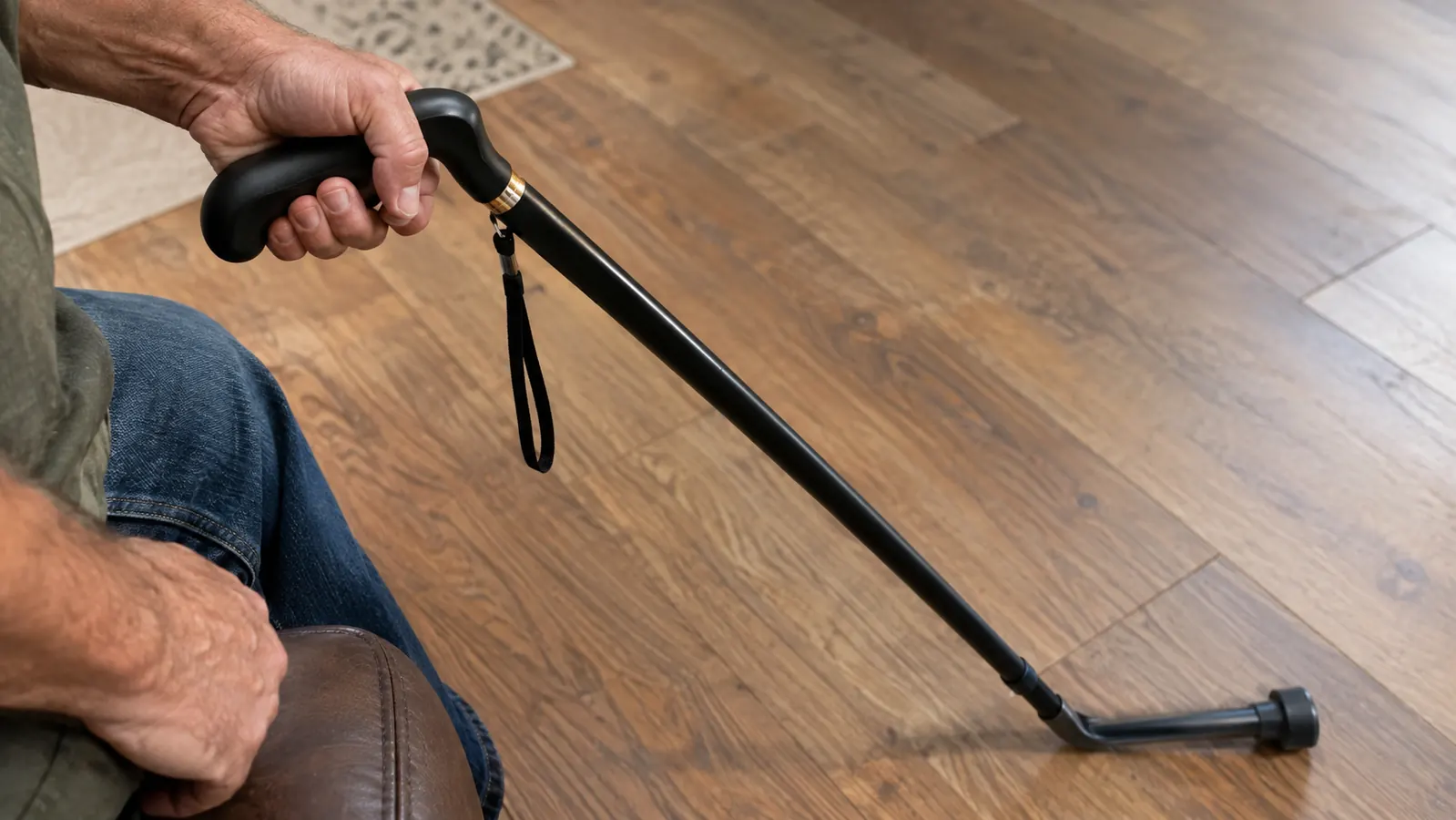
The grip is the part people overlook, and it is the part that will make or break your daily use. With MS, my grip strength comes and goes. On a bad day I cannot close my hand fully around a thick handle. That is why I have strong opinions here. The HurryCane uses a curved handle that follows the natural shape of your palm, so your fingers can rest around it without having to squeeze hard. I can hold it loosely and still keep control of it, which matters when my hand is tired. One afternoon in April, after a long morning of errands, my right hand was so fatigued that I could barely hold a coffee mug. I still managed the walk from the car to the front door with the HurryCane because I did not need to grip it hard. That was the moment I stopped missing my old straight handle.
If you have arthritis in your fingers or a weak grip, look for a handle that is wide enough to spread the pressure across your palm, with a smooth surface that does not bite into your skin. If you have very small hands, a thinner handle may suit you better. There is no universal right answer. There is only the answer for your hand. I keep a gel grip cover on mine for extra cushioning on long days, and it helps a lot. My sister-in-law, who has arthritis in both thumbs, tried my cane once and handed it back immediately. The curved handle did not suit her grip at all, and she does better with a wider foam grip on a straight cane. We are both right. That is why I tell people to test the grip in their own hand for a few minutes before they buy, not just squeeze it once in the store.
Step 3: Check the wrist angle before you commit
Here is a test that takes ten seconds. Grip the cane the way you would in real life, stand tall, and look at your wrist. If your wrist is bent sharply up, down, or to the side, the cane is not right for you. Your wrist should stay close to neutral, in line with your forearm, so the weight of your body travels straight down through your arm and into the shaft.
The HurryCane has a slight ergonomic curve in the shaft that I did not expect to notice, but I do. It angles the handle so my wrist stays in a more natural position than it does with my old straight cane. That sounds like a small thing. It is not small. After an hour of walking around the mall, my wrist used to ache. With the HurryCane, it does not.
Step 4: Test the cane in your own house, not the store
You cannot tell if a cane fits by leaning on it for thirty seconds in an aisle. You have to walk with it. Walk down a hallway. Turn around. Go up and down a curb if you have one. Sit down and stand up from a chair. That last one is the test that matters most to me, because getting up from a low sofa is the hardest thing I do all day. Our living room couch sits low, and on a bad leg day I need the cane to take a real share of my weight while I push up. A cane that is too tall makes that motion awkward, because you are pushing down at an angle instead of straight. I test every cane against that couch before I trust it anywhere else.
The HurryCane folds in half, which makes it easy to keep in my bag for the car, but folding does not make it flimsy. The locking mechanism feels solid when I click it into place, and I have never had it fold on me mid-step. I have had that happen with a cheaper folding cane, and it is not an experience I want to repeat. Test the locking mechanism yourself before you trust it. I fold and unfold mine every time I get in and out of the car, because it rides in the passenger footwell next to my bag. After three months of that routine, the joint still clicks shut with the same firm snap. That daily test tells me more than any spec sheet.
Give yourself a full week of real use before you decide whether a cane fits. Your arm muscles need time to adjust. The first two days with any new cane will feel awkward. By day five, you will know whether the height is right and whether the grip suits your hand. That is the honest timeline, and it is worth respecting. The third day is usually the worst, because the novelty has worn off and your shoulder is still grumbling. By the end of the week I had stopped thinking about the HurryCane entirely, which is the highest compliment I can give a walking aid.
Step 5: Buy from somewhere with a real return policy
You will not know if a cane works until you have lived with it for a few days, so buy from a place that lets you return it if it does not work. That is not a small consideration. My first cane came from a medical supply store with a no-return policy, and I was stuck with a cane that was wrong for me. I do not want you to make that mistake. I bought it in February of last year, told myself I would adapt, and kept using it long after I knew better. The store would not take it back, and I could not in good conscience pass it along to anyone else. That lesson is why I now check the return policy before I check anything else.
The HurryCane Freedom Edition is sold on Amazon with a standard return window, which is one of the reasons I felt comfortable testing it in the first place. I adjusted it, walked with it, folded it, unfolded it, and put it through a few weeks of real errands before I formed my opinion. That is the experience you want to be able to have too. I took mine to the grocery store, to the post office, and on the two-step walk up to my own front door, which is the most honest test of all because it is the one I repeat every single day. A cane that passes the daily test is a keeper.
And when it arrives, do not throw away the box until you are sure. Keep the packaging, keep the receipt, and give yourself permission to send it back if your body says no. A cane is a tool. It has to fit you, not the other way around. I know how tempting it is to decide you will make it work, because I did exactly that with my first cane. Nobody wants to admit they bought the wrong thing. But your body will tell you the truth faster than your pride will, and the return window exists for exactly that reason.
What Else Helps
A well-fitted cane does a lot, but it is not the only thing that makes my days easier. I wear shoes with a firm sole and a low heel, because squishy sneakers make me less stable. I keep a small folding stool in the car for the times I need to sit down in a parking lot. And I do my grocery shopping at a store where the carts are light and easy to push, because leaning on a cart is sometimes steadier than leaning on a cane. My physical therapist calls these my workarounds, and she approves of all of them.
If your weakness is anything like mine, you should also talk to your physical therapist about your specific gait before you spend money on a cane. They can watch you walk and tell you things no online guide can, like whether you are compensating with your hip or swinging your leg in a way that will cause problems later. I did that, and it changed which cane I bought.
A cane that fits lets you walk farther with less effort. A cane that does not fit throws off your posture, tires your shoulder, and can make you less steady, not more.
Fit yours to your wrist crease and your hand
The HurryCane Freedom Edition adjusts in seconds, folds for the car, and comes with a return window so you can test it in your own hallway. Check today's price on Amazon.
Amazon Check Today's Price on Amazon →