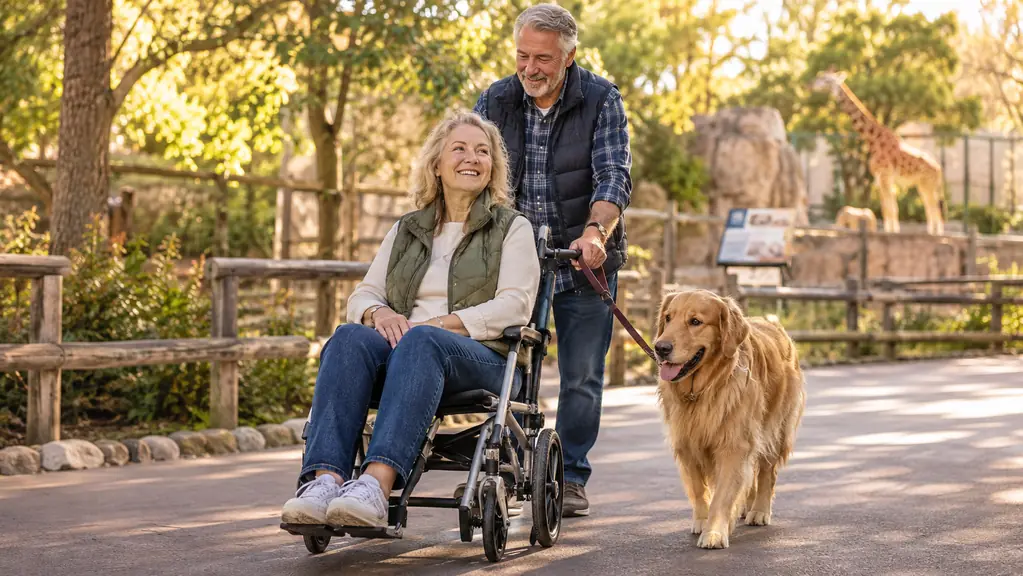
The first time Rob and I took the Medline transport chair to the zoo with our grandkids, I almost talked myself out of it before we left the driveway. The chair was new. I was tired. The forecast said 80 degrees, which is warm for me on a bad day. And some part of me still heard that old story in my head: that if I needed the chair, I might as well stay home. I am glad I ignored that voice, because that day worked. It was the second Saturday in June, the first day all three grandkids could come at once, and we had promised them the sea lion feeding for a month. The feeding starts at 11:30 sharp, so we aimed to be through the gate by 9:30, which meant the whole morning had to run on schedule. We packed the chair the night before, loaded it into the back of our 2019 Honda CR-V before breakfast, and still almost turned around twice on the drive there. We spent five hours out, I saw the sea lion feeding, and I came home tired in a good way instead of wrecked in a bad one. This is how we planned it, and how we plan every big day out now.
A transport chair is the piece of equipment that made those days possible for me. The Medline model we use folds flat enough to ride in the back of our 2019 Honda CR-V, weighs about 24 pounds, and rolls on 12-inch wheels with handbrakes on the push handles. It is not a wheelchair you propel yourself. It is a chair someone pushes, which means the planning has to include both of us: what I need to sit through, and what Rob needs to push through. Here is the whole system, step by step.
Start with a chair you can actually get in and out of the car
The Medline Lightweight Foldable Transport Wheelchair folds at the middle, locks open with a firm push, and fits in most trunks and hatchbacks. That one feature is the difference between a day out and a day spent wrestling equipment in the driveway.
Amazon Check Today's Price on Amazon →Step 1: Decide what the day actually needs from you
Before I book anything, I ask myself one question: what is the longest stretch I will need to be upright and walking? For me, with relapsing-remitting MS and left-leg weakness, the honest answer is usually about fifteen minutes on a good day. A zoo, an airport, a museum, or a long lunch runs way past that. So the transport chair is not a backup plan. It is the plan, and walking is the bonus.
That reframing changed everything. I stopped measuring the day by how much I walked and started measuring it by how much I saw. The chair does not mean I never stand up. It means I stand up when I want to, and I sit when my body tells me to, and neither one ruins the afternoon. Ask your physical therapist where you land on this, because it depends on your balance, your strength, and your endurance. For me, the chair is what lets me say yes to the invitation at all.
Step 2: Practice the fold and the car transfer at home first
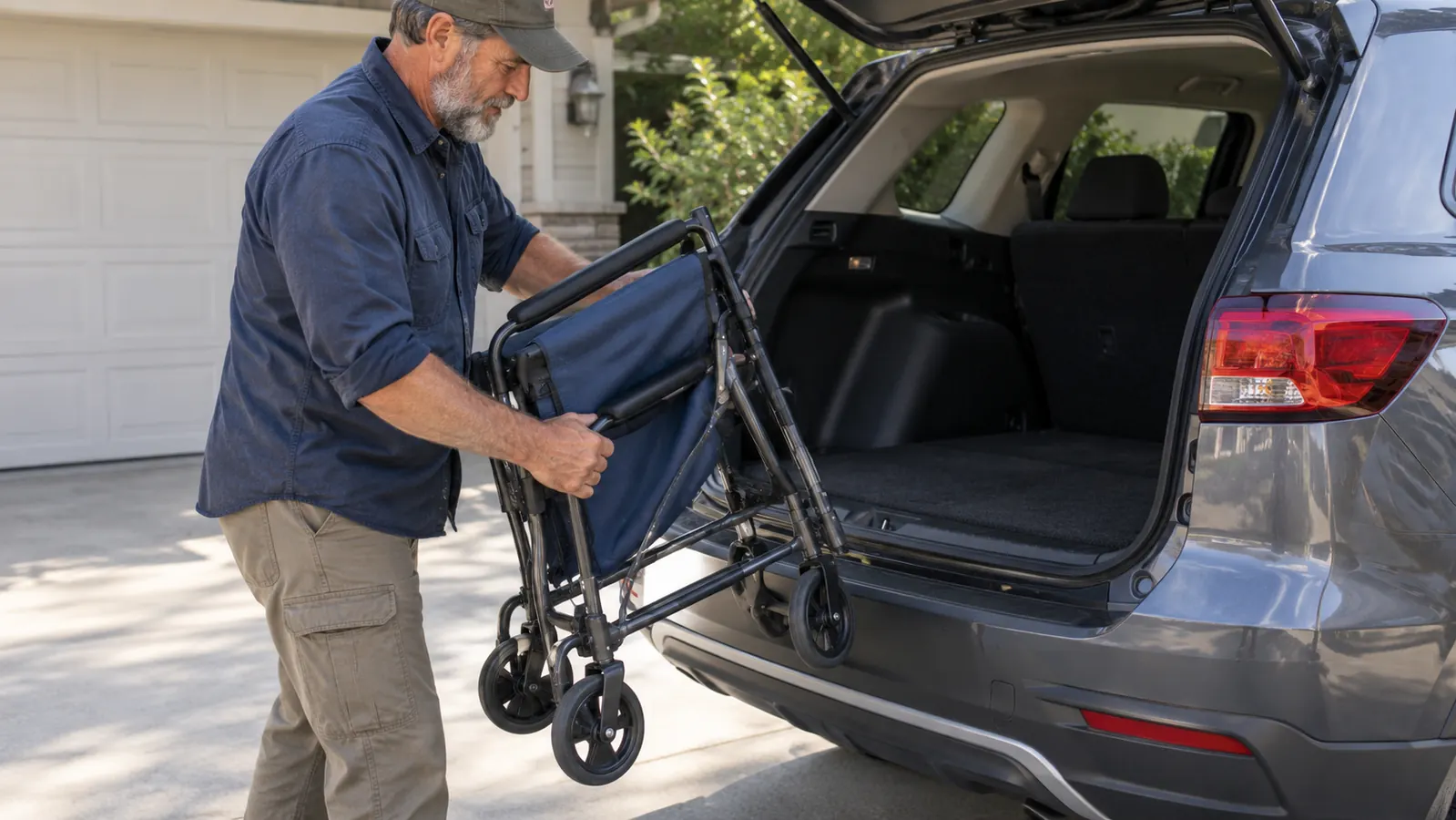
The Medline transport chair folds by lifting the seat and pulling the frame together at the middle. It sounds simple, and it is, but the first time you do it in a parking lot with a grandkid asking for a snack, simple is not the same as easy. So we practiced in the driveway for two afternoons, and I am glad we did. The first time Rob tried to fold it, he grabbed the push handles and lifted. The frame folded unevenly, caught on the footrests, and sprang back open hard enough to knock his shin. The trick, he figured out, is to lift from the middle of the frame with one hand on the seat release and the other on the crossbar, so the footrests tuck in instead of catching on the seatbelt latch. I learned my own lesson trying to get out of the chair in the garage: I stood up, turned, and sat down on the armrest instead of the seat because I had not moved the footrests out of the way first. Now I stand with my hand on the car door and turn before I sit, and I move both footrests up before I even try to stand. Neither of us timed it the first day. By the second afternoon we had the whole sequence smooth enough to do without thinking, which is the standard you actually want.
We also learned that the chair fits best in our CR-V with the back seat folded down and the chair slid in footrests first. Your car will be different. Measure your trunk or hatch opening before the day of the outing, and keep a small blanket or moving pad in the car to protect the upholstery from scrapes. The whole transfer takes us about ninety seconds now. It took us ten minutes the first time, and that is fine. The driveway is the place to be slow.
Step 3: Pack the chair bag like a pro
The Medline chair does not come with a storage pouch, so I made my own system. A small canvas tote hangs from the back of the chair and holds the things I actually reach for: a water bottle, a snack, sunscreen, a light scarf for air conditioning, and my phone. On the seat, I keep a folded blanket so the upholstery stays clean and so I have something to put under my legs if they get restless. I also tuck a second water bottle into the car, because heat is my enemy and I would rather carry too much water than cut a day short.
The one thing I do not pack is a lot of stuff. Every extra bag is something Rob has to manage while pushing, and pushing is his job. I keep my purse small, my tote light, and my expectations realistic. If I need something and forgot it, we buy it or we do without. The chair is for getting me out into the world, not for hauling the contents of my house along with me.
Step 4: Plan the route, the restrooms, and the exit strategy
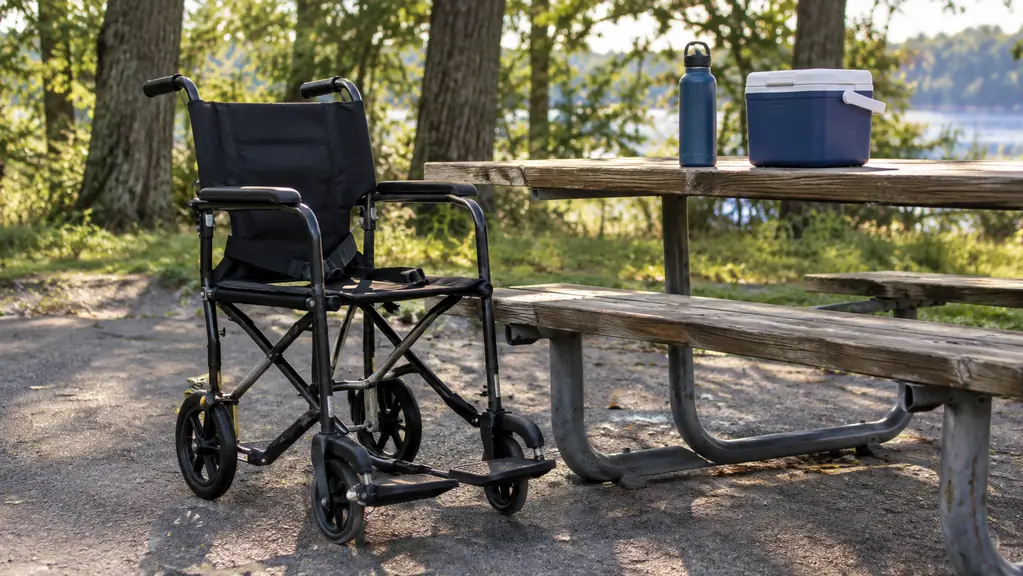
Before we go anywhere, I look at the venue's website and find three things: the accessible entrance, the accessible restrooms, and the route between them. I have learned the hard way that a venue can have a ramp at the front door and still have a gravel path to the restrooms in the back. Gravel is miserable in a transport chair. So is a path that is technically paved but has a two-inch lip at every threshold. Last spring we tried a nature center that advertised a paved trail loop. The first quarter mile was fine. Then the pavement gave way to packed gravel, then to loose gravel, and by the half-mile marker I was holding my feet up so my heels would not drag, while Rob worked twice as hard as he should have. We turned around, and the outing cost us both the rest of the afternoon. The nature center was a disappointment, but it taught me the question I now ask every venue by phone: is the path from the parking lot to the main entrance paved the whole way, and is the grade gentle? That one question has saved us more than once. A place can call itself accessible and still have a curb at the bottom of the ramp or a door that opens outward onto a landing too small to turn a chair on. Now I look for the words 'fully accessible' and then I look at the photos to see if I believe them. If the photos show a smooth path all the way to the door, I trust it. If they show one ramp and a lot of grass, I plan around it.
I also plan the exit before we arrive. Where is the car? Is there a curb cut? Can Rob push me up the slope to the parking lot, or should we park in the closer lot even if it costs more? For a big day out, I would rather pay for close parking and save my energy for the actual event. And I always know which staff member to ask for help if we need it. Most venues have someone whose whole job is helping people with mobility needs. Asking for help is not a failure. It is the reason they are there.
Step 5: Set the pace and protect the good hours
The biggest lesson from our zoo day was about pacing. I used to try to do everything in the first two hours, when I felt good, and then pay for it for the rest of the day. Now I plan the day in thirds, and I schedule the big attraction for the first third, when I am freshest. On the zoo day, that meant heading straight for the sea lion pool before the crowds found it. The second third was lunch at the picnic tables near the north entrance, where I could put my feet up on the chair's footrests and actually eat without rushing. The third third was the small mammal house and the gift shop, with an agreement that we could skip the gift shop entirely if my energy dropped. We were back in the car by 2:30, and I still had enough left to help make dinner that night. The first time we tried a big outing without the chair was back in April. We did the whole museum in two hours, I was done by noon, and Rob spent the drive home watching me go quiet and wiped out. That is the day I stopped treating the chair as a surrender. The chair gives me the option to keep going, but it does not obligate me to.
I also learned to listen to Rob. He is the one pushing, and his arms and back are part of the plan. We trade off: he pushes on the flats, I walk a little on the gentle stretches, and we both sit for lunch. A big day out works when it is a team effort. The Medline chair's handbrakes help on the downhills, and the 12-inch wheels handle paved paths and packed dirt better than I expected. But no piece of equipment replaces the basic rule: go slow, rest often, and quit while you are still having fun.
What Else Helps
A few extras made our outings noticeably smoother. A small wedge cushion helps me sit straighter in the chair and keeps my hips from getting sore on long pushes. A pair of lightweight gloves helps Rob grip the push handles in summer heat. And I always carry a printed or phone-saved copy of the venue map, so we are not trying to read a tiny screen while navigating a crowd. None of these are required. They are just the things I reached for again and again.
If you are shopping for a transport chair, the Medline model is a solid place to start. It is light enough for one person to lift when folded, sturdy enough for daily use, and simple enough that I did not need to read a manual to figure out the brakes. It is not the right chair for someone who needs to self-propel, and it is not a substitute for a proper wheelchair if you need to spend all day seated. But for a big day out, with a partner or family member pushing, it has been the difference between staying home and going.
We spent five hours out, I saw the sea lion feeding, and I came home tired in a good way instead of wrecked in a bad one.
Give yourself the option of a full day out
The Medline Lightweight Foldable Transport Wheelchair folds small, rolls smooth, and lets you save your energy for the parts of the day that matter. If you have been skipping the zoo, the museum, or the airport because walking is too much, this is the chair to start with.
Amazon Check Today's Price on Amazon →