
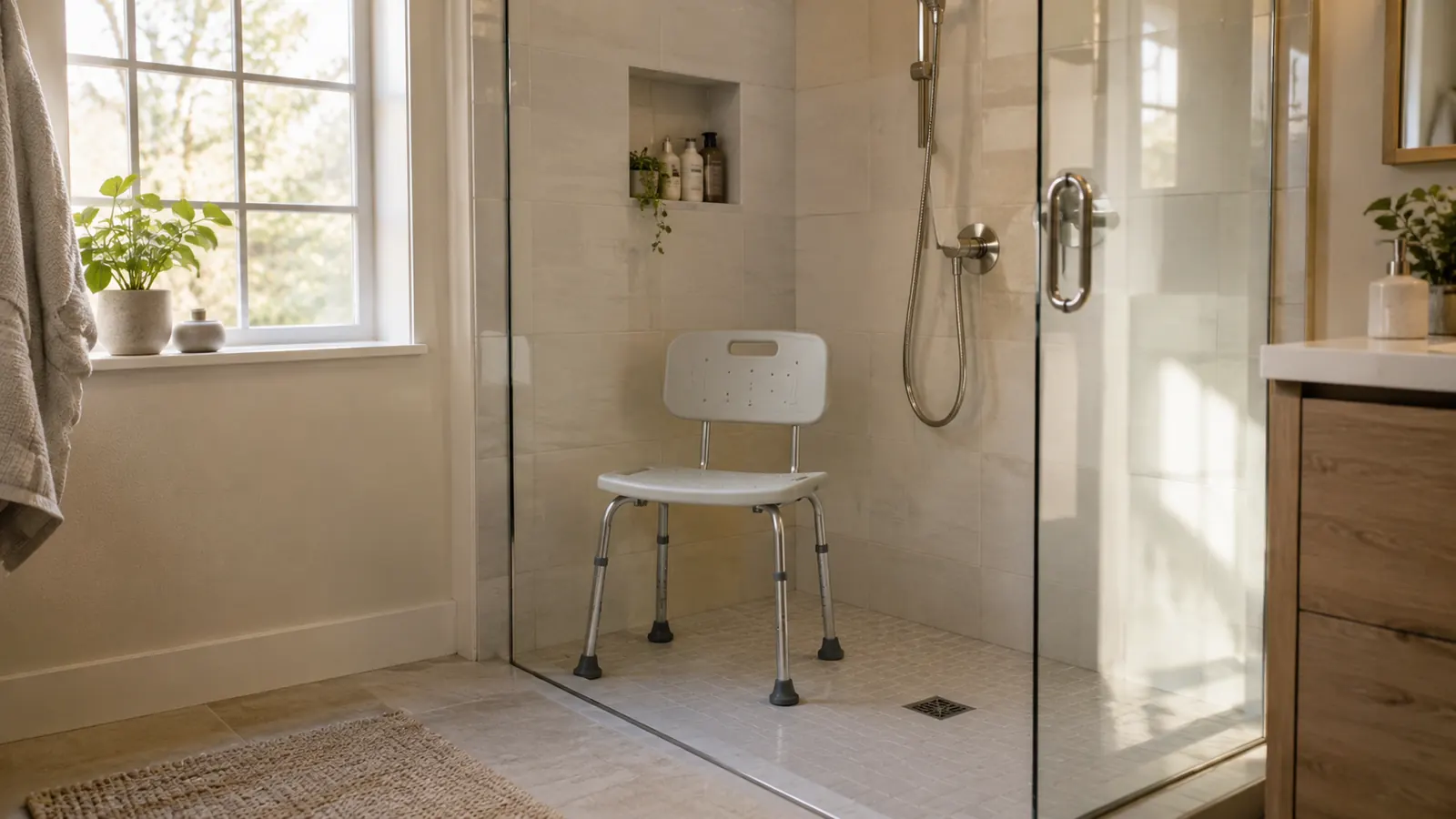
The hardest part of my bathroom remodel in 2022 was not picking tile or finding a contractor who showed up. It was admitting that I needed a chair in the shower. I have relapsing-remitting MS, and my left leg has a mind of its own on bad days. Standing on wet tile for a ten-minute shower stopped being a risk I could talk myself out of. So when we redid the bathroom, we put in a walk-in shower with a low threshold, and I bought the Medline Shower Chair Seat with Padded Armrests and Back to go with it. This is how I set it up, step by step, in case you are doing the same thing.
I want to be clear about what this guide is and is not. I am not a physical therapist, and I am not a contractor. I am a 58-year-old retired librarian in Fort Collins who happens to have spent the last two years figuring out what works in my own house. If your balance, strength, or bathroom layout is different from mine, run the setup past your physical therapist before you rely on it. What follows is the order that worked for me.
Start with a chair that can handle a wet bathroom
The Medline shower chair has a 350 lb capacity, adjustable legs, and padded armrests that make standing up from a seated position noticeably easier. It is the chair I use every day in my own walk-in shower.
Amazon Check Today's Price on Amazon →Step 1: Measure the shower floor and the doorway
Before you buy any shower chair, measure the actual footprint of your shower. Walk-in showers vary a lot. Mine is about 36 by 48 inches, which sounds generous until you put a 20-inch-wide chair in it and try to turn around. I measured the clear floor space from the wall to the showerhead, and from the threshold to the back wall, and wrote those numbers down before I ordered anything.
You also need to check the doorway. The Medline chair comes mostly assembled, but the legs are adjustable and the armrests are padded, so the whole thing is bulkier than it looks in the product photos. I measured the bathroom door opening and the shower opening to make sure the chair would fit through both without scraping the frame. It did, but barely, and I was glad I checked first.
One more measurement worth taking: the distance from the shower floor to the top of the seat you want. The Medline chair has four adjustable legs, and the seat height range is roughly 16 to 21 inches. I aimed for a seat height that put my knees level with my hips when I sat down, because that is the position that makes standing up easiest for me. Your physical therapist can help you find your own number. I also wrote down the slope of the floor while I had the tape measure out. Our contractor poured a new pan with a linear drain and a threshold about two inches high, and the pan drops a good quarter inch per foot toward the drain. That slope is the whole reason the legs need to be adjustable. A chair that sits perfectly level on the hallway floor will rock in the shower unless you set each leg to match the pan.
Step 2: Unpack and inspect every piece before you install
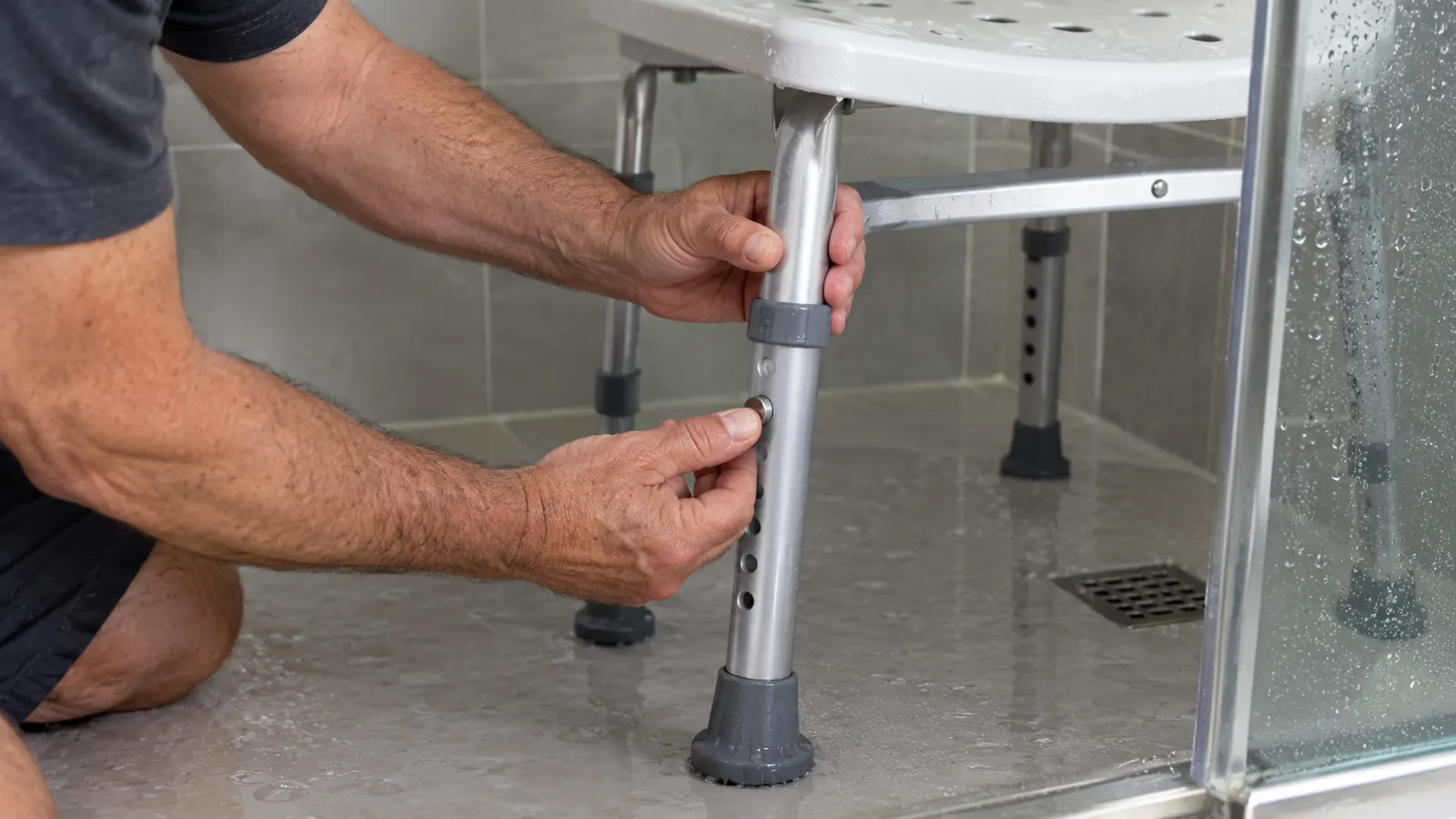
When the box arrived, I laid everything out on the bathroom floor: the seat, the backrest, the two armrests, the four legs, and the hardware bag. I checked each leg for the push-button adjustment mechanism and made sure the rubber feet were all present. The rubber feet matter more than you might think. They are what keep the chair from sliding on wet tile, and a missing foot is a safety problem, not a cosmetic one.
I also wiped down every piece with a damp cloth before assembly. The chair ships in a box, and the legs pick up dust and packing material. It is easier to clean the parts before you put the chair together than to reach around the backrest afterward. This is the kind of boring step I used to skip, and I have learned the hard way that boring steps are usually the ones that save time.
If anything is missing or damaged, do not start assembly. Contact the seller right away. I have bought enough mobility equipment to know that a missing rubber foot or a cracked leg is not something you can safely improvise around. The chair is only as safe as its weakest part.
Step 3: Assemble the chair outside the shower first
I assembled the Medline chair in the hallway, not inside the shower. The reason is simple: the shower floor is sloped toward the drain, and a chair with four legs does not sit level on a slope. It is much easier to get the legs adjusted and the frame square on a flat floor, then carry the assembled chair into the shower and make small adjustments there.
The assembly itself is straightforward. The backrest slides onto the seat frame, the armrests attach on each side, and the legs click into place with the push-button mechanism. I did not need any tools beyond what came in the box. The whole thing took me about fifteen minutes, and I am not handy. My husband Rob offered to help, but by the time he found his glasses, I had it together. One detail I nearly got wrong: the backrest has a front and a back. I slid it on facing the wrong way first, and the armrest brackets would not line up. Flipping it around took thirty seconds, but it taught me to look at the molded curves before forcing anything. I also learned to tighten the hand knobs firmly, not just snug. After a week of daily use, one of mine had worked loose, and the armrest wiggled when I pushed down on it. A quarter turn on each knob fixed it, and now I check them on the first Monday of every month when I clean the bathroom.
One thing I will say about the padded armrests: they are not just comfort. They give me something to push against when I stand up, which means I use my arms instead of my left leg. That has made a real difference on days when my leg is weak. If you are choosing between a chair with armrests and one without, I would take the armrests every time.
Step 4: Set the leg heights and level the seat
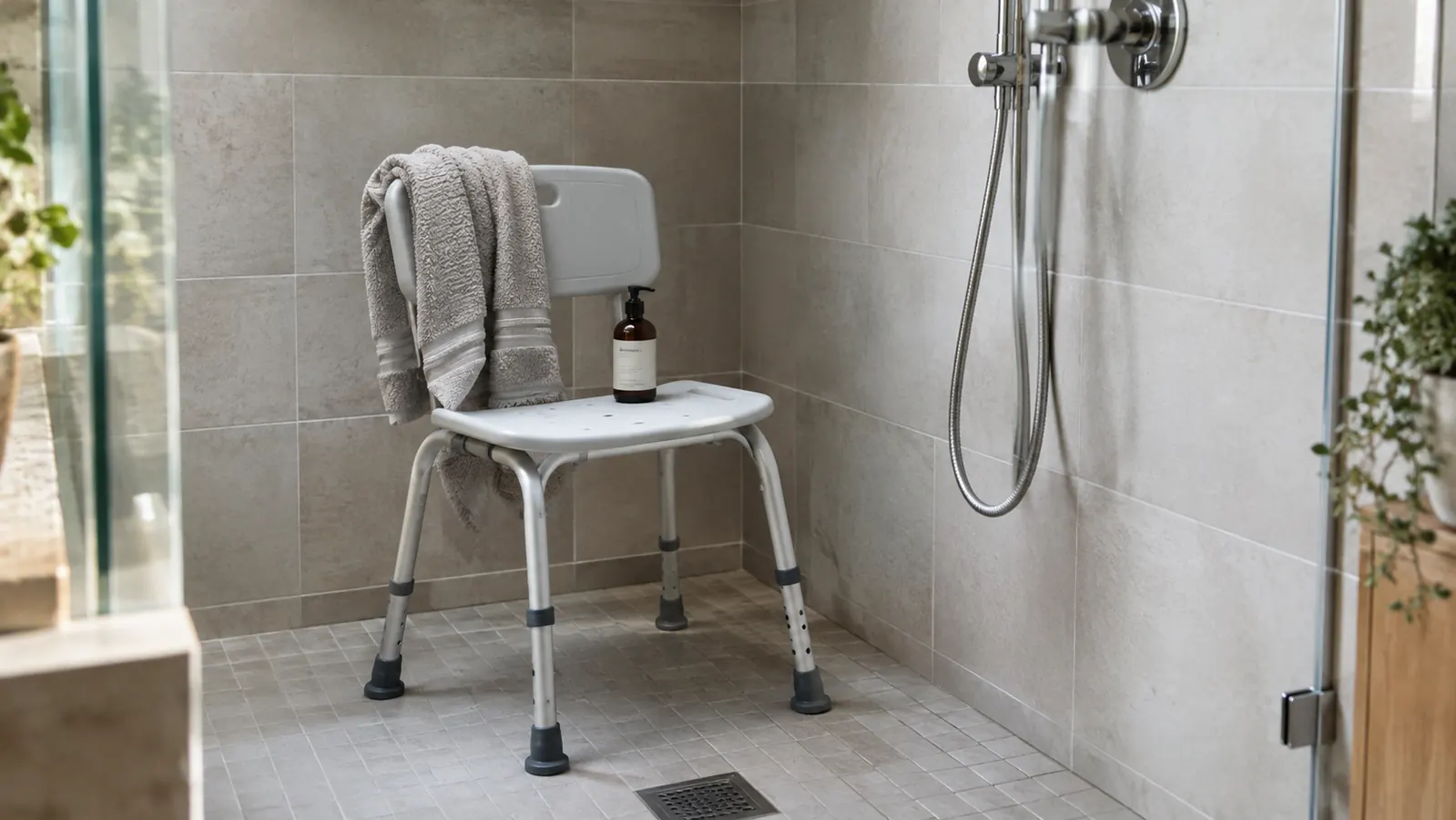
This is the step that separates a shower chair that works from one that wobbles. I carried the assembled chair into the shower, placed it where I wanted it, and then adjusted each leg individually. The push-button mechanism lets you press the button, slide the leg to the right height, and release. I did one leg at a time, checking the seat with a small bubble level after each one.
The seat needs to be level side to side and front to back, even though the shower floor is not. On my first attempt, the chair rocked slightly on the front left leg. I shortened that leg by one notch and the rocking stopped. That is the kind of small adjustment you cannot make if you assemble the chair inside the shower and never check it with a level.
Once the seat was level, I sat on it fully dressed, with my feet flat on the shower floor, and tested the height. My knees were at hip level, which is the position my physical therapist recommended. I also reached for the shower controls and the soap dish to make sure I could get everything without leaning too far. Leaning in a shower chair is how people end up on the floor, so I moved the soap dish before I ever took a wet shower. I did the reach test three times, once with my eyes closed, because that is how you reach for things when your face is full of water and shampoo. The built-in dish sat about six inches too high and slightly behind my shoulder, which meant twisting my torso every time. We moved it down and forward, and I hung a small suction-cup caddy on the side wall at elbow height instead. The grab bar took even longer to get right. We mounted it, I sat in the chair, and my hand landed two inches past it. We shifted it six inches closer to the showerhead, and now I can grip it without moving my weight.
Step 5: Do a dry run before you add water
I took two dry showers before I ever turned on the water. The first one was fully dressed, just to test the chair position and reach. The second one was with a towel and a robe, to practice the actual routine: sit down, reach for the soap, stand up, turn around. It sounds silly, but it is the difference between finding out a problem in the dry bathroom and finding out while you are wet and soapy. I did both dry runs on a Saturday morning, when Rob was home to hear me if I called out. That mattered more than I like to admit. The first time I sat down, I gripped the armrests and realized I had been holding my breath. By the second run, I could sit, reach the controls, and stand up without thinking about the order of movements. I timed myself too. The whole routine took about four minutes, which told me I would not be standing on wet tile for long.
During the dry run, I noticed that the shower curtain rod was slightly too close to the chair. When I sat down, my shoulder brushed the curtain. I moved the rod a few inches, and that fixed it. I also realized the towel hook outside the shower was too far to reach from the seat, so we moved it to the wall right beside the threshold. Those are exactly the kind of details you only notice when you sit in the chair and go through the motions.
After the dry runs, I took my first real shower with the chair. I kept one hand on the grab bar when I sat down and when I stood up, even though the chair felt stable. The Medline chair did not slide, the seat did not wobble, and the padded armrests gave me the leverage I needed. It was the first time in months that I did not dread getting into the shower.
What Else Helps
A shower chair is the centerpiece, but it works better with a few cheap additions. I use a non-slip bath mat outside the shower, because the floor right outside the threshold gets wet and slippery. I installed a grab bar on the wall next to the shower, positioned so I can reach it from the chair. And I keep a second towel on a hook within arm's reach of the seat, so I can dry off without standing up and reaching across the bathroom.
I also switched to a handheld showerhead with a long hose. That was the single best upgrade I made after the chair itself. With a handheld showerhead, I can sit in the chair and wash my hair without leaning back or standing up. If you are setting up a walk-in shower for someone with limited balance, I would put a handheld showerhead on the list right after the chair.
The first time I showered sitting down, I cried a little. Not because it was sad, but because it was the first shower in months that did not scare me.
The chair that made my shower feel safe again
The Medline Shower Chair Seat with Padded Armrests and Back is the chair I use every day. It is adjustable, stable on wet tile, and rated for 350 lb. If you are setting up a walk-in shower for yourself or someone you love, this is a good place to start.
Amazon Check Today's Price on Amazon →