

Nobody tells you how much of your life happens three inches off the ground. Curbs, door thresholds, the lip of a rug, the step down into the garage, the little ramp at the back door of the library. When my left leg started giving out on me, I spent a month gripping doorframes and apologizing for walking slowly. I tried a standard cane from the pharmacy, then a nicer one from an online shop, and both did the same thing: they helped me stand, and they did nothing for my confidence on uneven pavement.
That is why I ordered the HurryCane Freedom Edition. I have had relapsing-remitting MS for fourteen years, and on good days a cane is enough to get me around Fort Collins. I wanted something that folded, that I could keep in the car, and that felt steadier on the walk from the parking lot to the grocery store. Six weeks later, I have opinions. Some of them match the reviews you have already read. Some of them are the parts people leave out, and this review is about those.
The Quick Verdict
A folding cane that genuinely feels steadier on uneven ground. Buy it for the four-point base, not the marketing, and give yourself a week to learn its quirks before you decide you love it or hate it.
Amazon Check Today's Price →The folding cane that finally made curbs feel doable
If you are shopping for a cane that folds small and rides along in the car, the HurryCane is the one I keep reaching for. It is not perfect, and I will show you exactly where it annoys me. But it is the one that stays in my car instead of my closet, and that alone has changed my average Tuesday.
Amazon Check Today's Price on Amazon →How I've Used It
For the last six weeks, the HurryCane has been my everyday good-day cane. Most mornings I take Penny, our seven-year-old beagle mix, on a slow loop around the block. Penny is twenty-four pounds of patience and she walks at exactly my speed, which is why she is the best physical therapist I have ever had. On those walks I use the cane the whole way, about twenty minutes, mostly on sidewalk with one stretch of cracked pavement, a gravel patch, and a curb at each corner. That mix of surfaces is exactly what I wanted to test.
I also carried it on real errands. The grocery store, the library, the pharmacy, the post office, and one long Sunday at the zoo with our grandchildren. On longer outings I usually take my rollator, and for big days Rob pushes the folding transport chair into the car and I ride when my legs say no. The cane was the middle option, the one I grabbed when I needed my hands free and wanted more support than a bare hand on a doorframe. It lived in the door pocket of our 2019 Honda CR-V, folded, so it was always there when I parked, and that is the whole point of a folding cane.
A note on how I tested it, because honesty matters more than polish. I am not a physical therapist and I am not going to give you medical advice. I am a retired middle-school librarian with relapsing-remitting MS, diagnosed fourteen years ago, and my limits are fatigue and left-leg weakness. Heat makes both worse, so my bad days cluster in July and August. If your needs are different, ask your physical therapist whether a four-point cane makes sense for your balance and your grip. What follows is one person's experience over six weeks, not a prescription.
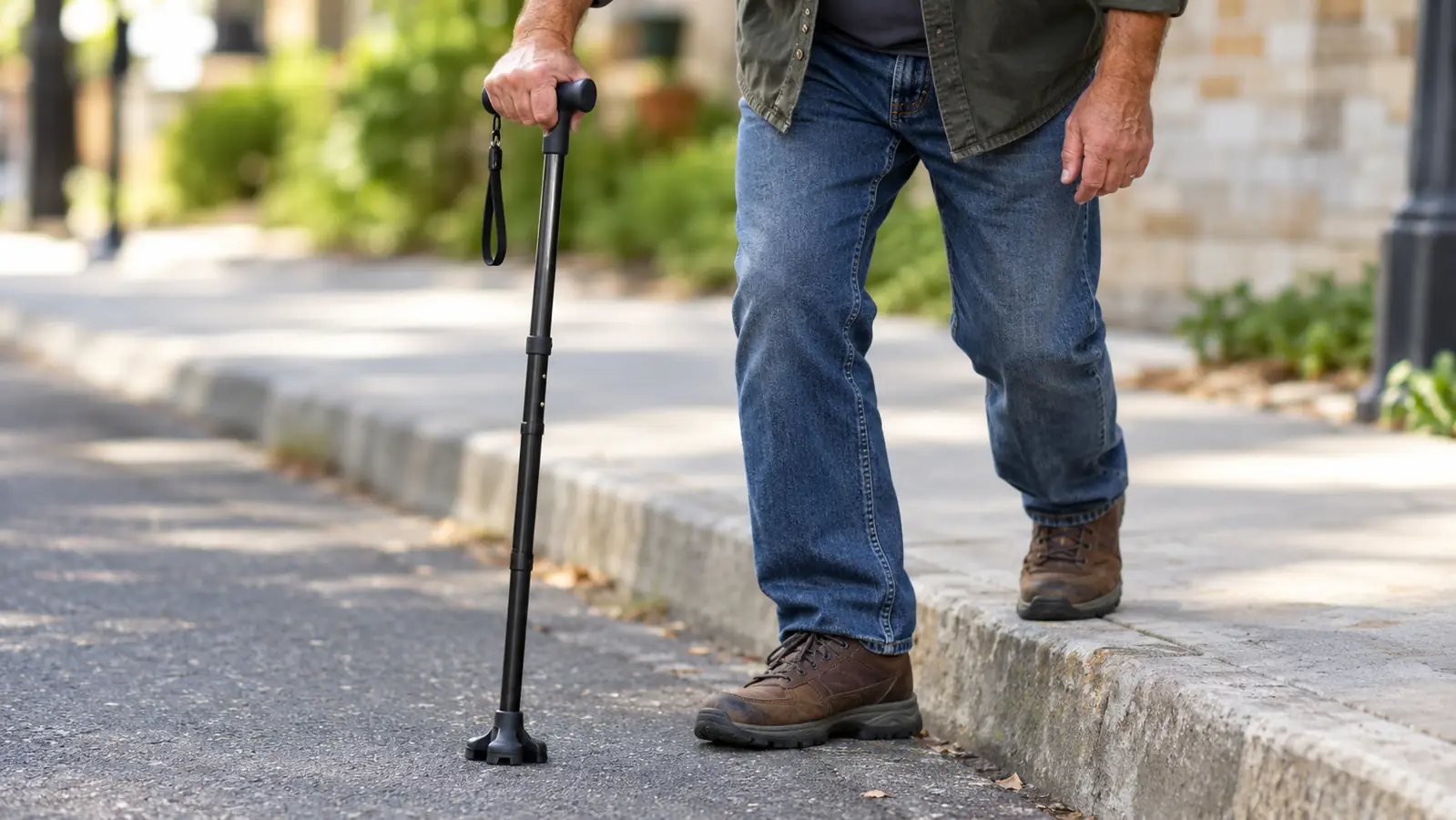
What the Ads Don't Show You
The first thing you notice is the base. The HurryCane does not end in a single point like a standard cane. It ends in four small feet, and that changes the whole feel of walking. When you put your weight on it, it does not wobble the way a single tip does on a slightly uneven sidewalk. When you set it down, it stands by itself. I cannot tell you how many times my old cane rolled off a table or fell over in a store aisle. This one stays where you put it, and that is a bigger deal than it sounds.
The second thing you notice is the weight. Nobody tells you this, but the HurryCane is heavier than a standard cane. Part of that is the base, part of it is the folding hardware, and you feel it on a twenty-minute walk. It is not heavy enough to bother me, but it is enough that I notice it, and if you have very weak arms or a bad shoulder you will notice it more. The tradeoff is real: more stability costs more effort to carry. I decided the tradeoff was worth it. You should make that decision with your eyes open.
The third thing is the sound, and the fourth is the grip, and both are details you only learn by living with the thing. On hard floors, the four feet make a clicking noise with each step. Click, click, click, across the library linoleum. It is not loud, but it is there, and if you are self-conscious about being noticed, you will be aware of it. The grip, meanwhile, is a molded T handle, and it gives your palm a flat place to rest. A round handle concentrates pressure into a thin line across your hand, and by the end of a walk I used to have a red crease in my palm. The T handle spreads that pressure out. My husband Rob says he can hear me coming, which he claims is a feature, and honestly, for a man who has spent thirty years losing his keys, maybe it is.
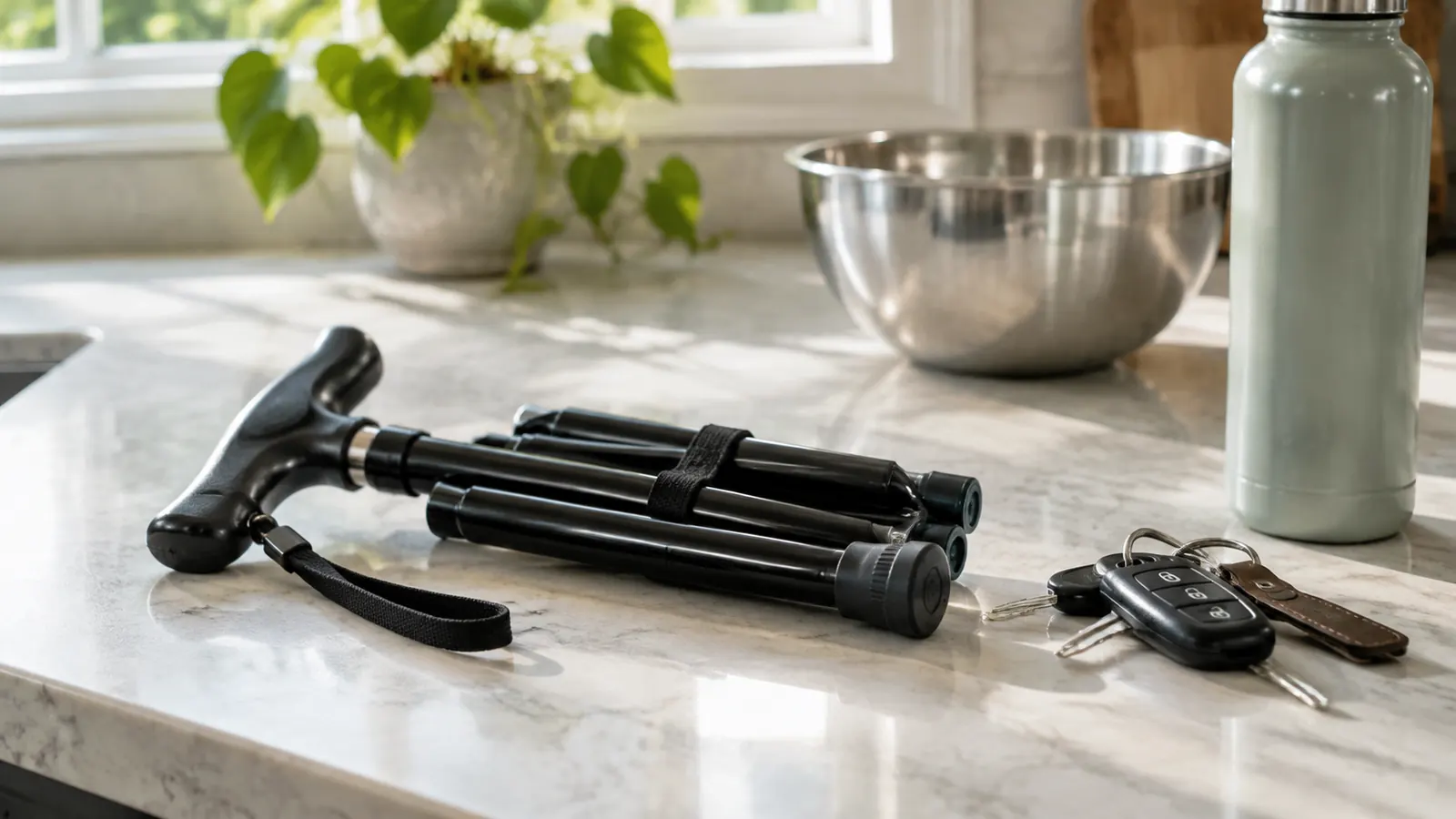
The folding mechanism deserves its own paragraph, because it is the part the ads glide over. The cane collapses into three sections, which is what makes it so easy to keep in the car. But the first few times, I had to look at the little diagram printed on the strap to figure out how to fold it. You pull a collar down on each joint, and the sections come apart. Putting it back together takes a bit of force and a bit of practice. If you have arthritis in your hands or limited grip strength, this is the part to test before you buy.
How It Held Up Over Six Weeks
I kept a small notebook while I tested it, which is the librarian in me. The cane went on thirty-one walks and into the store at least a dozen times. It folded and unfolded cleanly every single time. The height adjustment, which is tool-free, held its setting through all of it. The rubber feet on the base show some wear on the two that take most of my weight, which is exactly what I expected, and I have already ordered a spare set of replacement feet so I do not get caught out.
The only real problem I ran into was thresholds. The base is wider than a single point, which is what makes it steady, but that same width catches on things. The lip of our front door, maybe half an inch tall, stopped me cold the first week. The gap at the bottom of an elevator caught it once. You learn to lift the cane slightly over those spots, and after a few days the little lift becomes automatic. But nobody tells you about it beforehand, and the first time it happens you will think you are doing something wrong. You are not.
One more thing about durability, because I know that is why you are reading an honest review. The strap that holds the sections together when folded has held up fine. The push buttons on the height adjustment have not stuck once. The grip has softened slightly where my palm rests, which is normal for a cane you actually use. Nothing has broken, nothing has loosened, and nothing has needed adjustment. For a piece of equipment that lives in a car door pocket and gets thrown onto the back seat, that is a good report.
The zoo day was the real test. Our three grandchildren visit most Sundays, and last month we took them to the zoo, which means walking paths, hills, a train ride, and a lot of standing. I took the rollator that day, not the cane, because I knew my legs would need the seat. But I brought the HurryCane folded in my bag as backup, and I used it for the stretches between benches where the rollator felt like too much. Having a cane that folds small enough to disappear into a tote while you push a rollator is a combination I had not thought about before, and it turned out to be the most useful thing I did all month.
The moment I knew the HurryCane was worth it: I set it down in the grocery aisle and it stood there by itself while I reached for a jar on the bottom shelf. My old cane would have been on the floor at my feet.
The Tradeoffs Nobody Mentions
Let me give you the honest list, the one I wish someone had handed me before I ordered. The cane is heavier than a standard one, and it clicks on hard floors. It catches on thresholds until you learn the little lift. The folding joints need a firm hand. The replacement feet are an ongoing cost, not a one-time purchase. And when it is folded, it is not as compact as some travel canes; it fits in a tote bag, but it is not disappearing into a coat pocket.
Here is the thing I want you to understand. None of those are reasons to skip it. They are reasons to buy it with your eyes open. The marketing photos show a woman gliding down a path on a perfect afternoon. They do not show the first frustrating week, the threshold that stops you, the click on the linoleum, the moment you have to ask someone to hold the elevator because the gap ate your cane tip. Knowing about those moments beforehand is the difference between thinking you bought a lemon and realizing you just need a week to learn a new tool.
What I Liked
- The four-point base stands on its own, so the cane never rolls away or falls over
- Folds into three sections, easy to keep in a car door pocket or a tote
- Feels noticeably steadier on cracked pavement and gravel than a single-point cane
- Tool-free height adjustment that held its setting through six weeks of daily use
- The T handle is comfortable for shorter walks and easy to grip
Where It Falls Short
- Heavier than a standard cane, and you feel it on longer walks
- The wide base catches on door thresholds and elevator gaps until you learn the lift
- Makes a clicking sound on hard floors
- Rubber feet wear down and replacements are an extra purchase
- Folding it takes hand strength, which not every cane user has
Alternatives I Considered
I compared the HurryCane to the standard single-point cane I already owned. The standard cane is lighter, cheaper, and quieter. It also falls over constantly, slides on smooth floors, and does not fold, which means it stays home when I drive anywhere. For me, the HurryCane won on the tradeoff that mattered most: it was always in the car, and it stood up by itself when I needed both hands for a grocery bag.
I also thought hard about whether my rollator made the cane pointless. It does not. The rollator is better for long outings where I need to sit down, and on bad days it is the only thing that works. But it is a production. It goes in the back of the CR-V, it takes up space in a store aisle, and it announces itself to everyone in sight. The cane is the quiet middle option. On a good day at the farmers market, the cane is enough, and I am not wrestling a walker out of the car for a twenty-minute errand.
The other alternative I considered was doing nothing, which is what a lot of us do. I told myself for a year that I did not need a cane for short trips, that I could hold the car door with one hand and the shopping cart with the other. That worked until it did not. A cane that folds and lives in the car is a way of admitting, quietly, that some days need support, without turning every errand into a production. That admission is worth more than the cane costs.
Who This Is For
The HurryCane is for you if you have decent hand strength, you walk on a mix of surfaces, and you want a cane that lives in the car instead of the closet. It is for people whose balance is good enough that a cane is genuinely enough on most days, and who want a little extra insurance on uneven ground. It is for the person who is tired of picking a cane up off the floor, or the family member who is tired of watching them do it. If that sounds like you, this review is probably the one you needed to read.
One more thing about who this is for: the person buying it. A lot of the people reading this are not buying for themselves. They are buying for a parent, a spouse, a sibling, and they are doing it because the person in question will not admit they need help. I have been that person, and I have also been the one doing the buying. The HurryCane is a good gift because it does not look like medical equipment. It looks like a nice walking stick, it folds away, and it does not announce itself. That matters more than you think.
Who Should Skip It
Skip it if you need to sit down when you rest, because a cane is not a seat and it never will be. Skip it if your grip is very weak, because the folding joints and the T handle both ask something of your hands that a standard cane does not. Skip it if you walk mostly indoors on hard floors, because the click and the threshold-catching will wear on you. And if your balance is unsteady enough that you reach for walls on a normal day, talk to your physical therapist about a rollator or a transport chair before you spend money on any cane. There is no shame in needing more support, and no cane fixes that.
And one more group: if you already own a cane that works and you are happy with it, do not replace it just because this one folds. A new cane is not an upgrade the way a new phone is. It is a tool, and the best tool is the one you actually use. The HurryCane only wins if it gets used, and for me it does.
The Bottom Line
I have owned a lot of assistive gear in fourteen years with MS. Some of it sits in a closet, expensive and untouched, because it was bought for the person I hoped to be instead of the person I am. The HurryCane is not that. It is the cane I reach for on a good day, the one that rides in the car, the one that stands by itself in the grocery aisle while I use both hands for the shopping list. It has flaws, and I have listed every one of them. But it has stayed in rotation for six weeks, which is more than I can say for most of the things I have bought since my diagnosis.
Still deciding? Here is my bottom line.
The HurryCane Freedom Edition will not fix a bad day, and it will not make itself invisible. But it is the folding cane I reach for when I want to walk the dog without holding a doorframe, and it is the one that has stayed in my car for six weeks instead of living in a drawer. If that sounds like your Tuesday, it is worth a try. And if it is not, I hope you find the tool that is.
Amazon Check Today's Price on Amazon →