

I have pushed a lot of wheelchairs in my life, but I had never been the one sitting in one until my MS made long distances a gamble. On good days I walk with a cane. On medium days I use my rollator. And on big days, the ones that involve airports or the zoo with the grandkids, my husband Rob pushes me in a Medline transport chair. This is the honest review I wish someone had given me before we bought ours, the one that tells you what the product page leaves out.
The Quick Verdict
A solid, no-frills transport chair that does exactly what it promises: gets you through a long day without wrecking yours. Just know that it is a two-person tool, not a solo mobility aid.
Amazon Check Today's Price →The transport chair that gets us through airport days
After a year of using it for travel, zoo trips and long clinic visits, this is the chair we keep reaching for. See today's price on Amazon and decide if it fits your family's big days.
Amazon Check Today's Price on Amazon →How I've Used It
We bought our Medline transport chair in the spring, after a trip to the Denver airport nearly ended with me in tears and Rob carrying the rollator through security. The rollator is fine for a mile of flat sidewalk. It is not fine for a half-mile walk to a gate, a shuttle, another walk, and then the same thing in reverse. So we did what a lot of families do: we added a transport chair to the equipment closet.
The trip that pushed us over the edge was a flight to Seattle last April to see our daughter. We parked in the economy lot, rode the shuttle, walked what felt like half a mile to the security checkpoint, and then discovered our gate was at the far end of concourse B. By the time we reached the gate, my left leg was shaking and I was close to tears. Rob had carried the rollator through security and was doing the same with my carry-on. We made the flight, but I spent the first hour with my feet up, too wiped out to enjoy any of it. The plane was the easy part.
I spent two weeks researching after that. I read reviews, watched videos, and almost rented a chair at the airport instead of buying one. Renting was going to cost nearly as much as a basic chair for a single weekend, and I knew we would need it again. The rental desk is also at the far end of the terminal, which defeats the purpose. A friend from my MS support group let me try her chair in her living room, and that sold me on the folding design. I ordered the Medline the next day.
Our first real outing was a grocery run, of all things. We needed milk and bread, and I wanted to test the chair somewhere small before trusting it with a crowd. Rob pushed me down the produce aisle while I held the basket in my lap. It felt strange at first, being pushed past shelves I could have reached myself a year ago. By the time we reached the checkout, the strange feeling had turned into relief. I had walked maybe two hundred steps all morning, and I was not exhausted. We have done a dozen grocery runs the same way since.
The honest version of this review is that a transport chair is not a wheelchair. It has no self-propulsion, which means someone else has to push. For our family, that is the point. Rob gets the exercise, I get the stamina, and we both get to actually enjoy the outing instead of planning it around my walking limits.
What Nobody Tells You About the Weight
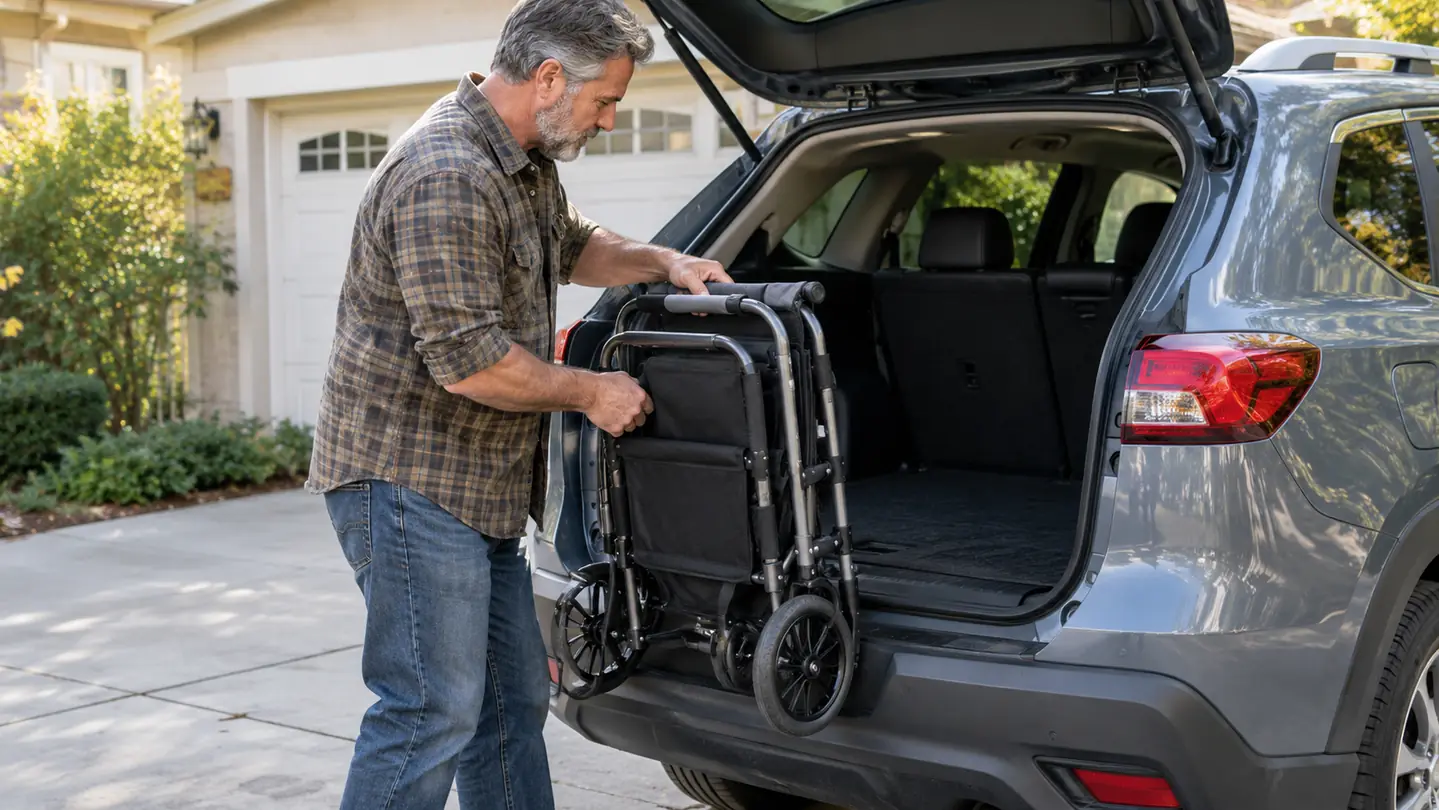
The product title says lightweight, and it is, as far as transport chairs go. But lightweight is a relative word. This chair weighs around 20 pounds, and when Rob lifts it into the back of the CR-V, he does it with one smooth motion. When I try to lift it, I can manage it, but I would not want to do it on a bad day. If you are the person who will be loading and unloading the chair by yourself, test that motion before you buy.
The first thing I did when the box arrived was put the chair on our bathroom scale. It read 19.5 pounds, which matches the listing. That number sounds light until you are standing in a driveway at 7 in the morning with the chair in one hand and a travel bag in the other. On a good day I can manage it. On a day when my left leg is not cooperating, I do not even try. Rob loads it before we leave the house, and that is our system now.
The folding mechanism is the part that took us the longest to learn. It is not hard, but it is specific. You pull up on the seat, the sides fold in, and the whole thing collapses into a shape that fits behind the front seats of our CR-V, standing on its side with the wheels facing the door. The latch that holds the frame open sits under the front edge of the seat, and if you do not push it fully closed, the chair folds up on you the moment you let go. The first time that happened, it was in our garage and the chair landed on Rob's foot. Not hard, but enough to make us pay attention. Now Rob can do it in about ten seconds, and I can do it in about twenty, bracing the chair against my hip while I work the latch.
The handbrakes on the push handles are the feature I would not give up. They let Rob hold the chair steady on a slope, and they give me a feeling of security that a chair without brakes simply cannot offer. The brake levers are cable-actuated, and they need a firm squeeze. Rob tested them the first week by parking the chair on the sloped part of our driveway and letting go. It held. That test cost us nothing and told us everything.
The handbrakes are the feature I would not give up. They let Rob hold the chair steady on a slope, and they give me a feeling of security that a chair without brakes simply cannot offer.
The 12-Inch Wheels Are the Tradeoff
Here is what the product photos do not show you. The 12-inch rear wheels are small, and small wheels mean every crack in the sidewalk feels like a speed bump. The wheels are solid rubber, which means no flats, but also no give. On smooth indoor floors, the Medline chair glides beautifully. On the brick paths at the botanical gardens, it vibrates. On a gravel path, it is genuinely unpleasant, and I usually ask Rob to find the paved route instead.
The morning that taught us the most was a Saturday at the farmers market in Old Town Fort Collins. The market runs along the wide brick sidewalks on Mountain Avenue, and the brick is beautiful and absolutely punishing in this chair. Every joint between the pavers sent a little shudder up through the seat. We made it two blocks before Rob said, 'this is worse than the gravel path at the zoo,' and he was right. We found the paved street route for the way back and enjoyed the market twice as much.
The front casters are the bigger surprise. They swivel, which makes the chair easy to steer, but they also catch on uneven surfaces. A half-inch lip at a store entrance can stop the chair dead. Rob has learned to give the chair a little running start at thresholds, and I have learned to hold on. This is not a flaw unique to Medline. Every transport chair with small wheels behaves this way. But it is the thing I wish someone had told me before our first trip to a farmers market.
The curb cut at the corner of Mountain and Linden has a lip of maybe half an inch, and the first time we hit it, the chair stopped dead and I lurched forward. Rob learned to tilt the chair back onto its rear wheels for a second, roll the front casters over the lip, and set it down. It sounds dramatic. It takes about two seconds, and now he does it without thinking. If you will be the pusher, practice that tilt on a quiet sidewalk before you need it in a crowd.
The flip side is that the small wheels are exactly why this chair fits in a car trunk at all. A full-size wheelchair with big wheels does not fold as flat, and it weighs twice as much. Our neighbor's standard wheelchair weighs close to 40 pounds and takes up most of the trunk. The Medline chair weighs 19.5 pounds and leaves room for the dog's crate and a couple of grocery bags. The Medline chair is a tradeoff, and for our use case, it is the right tradeoff. We are not using it every day. We are using it for the days when walking is not an option.
Comfort for the Person Sitting
I have spent up to four hours at a stretch in this chair, and I can tell you the seat is firmer than I would like. The longest single stretch was at the Denver airport, between check-in and boarding, with a two-hour layover on the way home. By the end of the day, my tailbone was complaining. The upholstery is a durable nylon that wipes clean, which matters after a day at the zoo, but it does not have much padding. I solved this with a two-inch foam cushion from a craft store in Fort Collins, the kind meant for a dining room chair, and now it is fine. If you are buying this for someone who sits for long periods, budget for a cushion.
The seat is about 18 inches wide, which is standard for a transport chair. I am a size 14 and I fit fine with room to spare. A neighbor, who is a big man, tried it once and found the seat snug. If the person using the chair is over about 250 pounds, measure the seat width against their hips before you order, because this is not a bariatric chair.
The armrests are fixed, which means they do not flip up out of the way. That makes transfers harder for someone who needs to slide sideways into the chair. I can transfer from my rollator with a pivot, because I still have enough strength in my arms to help. But the fixed armrests are the reason I would not hand this chair to just anyone. That is a real limitation of this model, and it is the main reason I do not give it a perfect score.
A friend from my support group tried the chair in our living room, and watching her told me more than any spec sheet. She has arthritis in her hips and needs to sit down from a standing position, which means she has to turn around and back into the chair. With the fixed armrests, there is no way to slide in sideways, and backing in is hard when your hips are the problem. She has a chair with flip-back armrests at home and manages fine with it. If the person you are buying for transfers the same way, look for a model with armrests that lift out of the way.
The footrests fold up and swing away, which is helpful for getting in and out. They are also the part that gets kicked most often. Rob has learned to check that both footrests are locked before he starts pushing, because a footrest that swings loose mid-ride will bump your heels and make you jump. The seat belt is a simple lap strap, and I will be honest, I rarely use it. Rob is careful, and the chair is stable, but if I were pushing someone with poor trunk control, I would want a chair with a more substantial harness. Ask your physical therapist about that one, because it depends entirely on the person.
What It's Like to Push
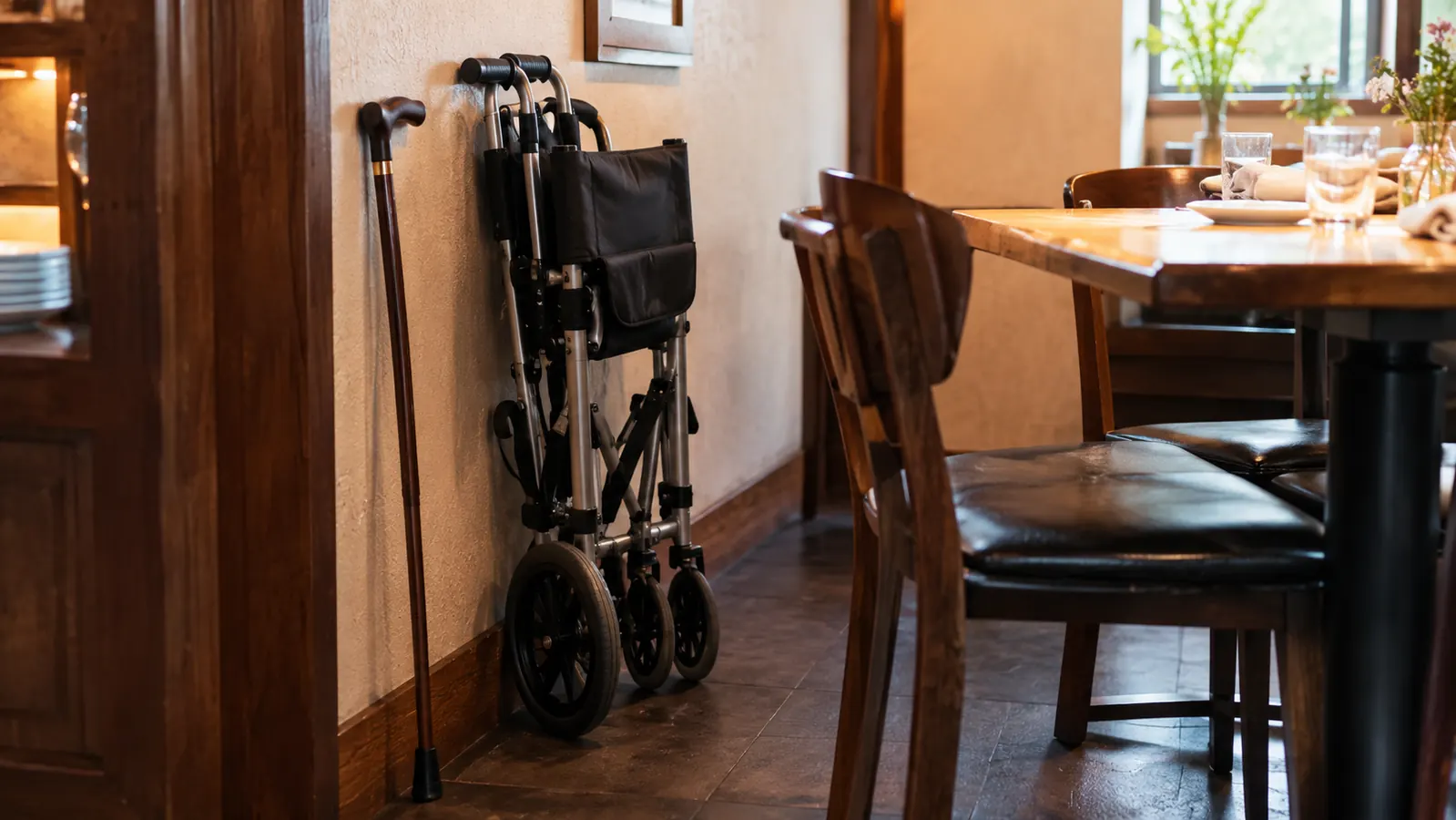
I asked Rob to write this section, and he said, and I quote, "It pushes easier than I expected." The chair is light enough that he can manage it with one hand on flat ground, which leaves the other hand free for a coffee or a ticket. The handbrakes are cable-actuated, and they work well, but they do require a firm squeeze. If you have weak hands, test the brake levers before you commit.
The push handles are padded and angled in a way that is comfortable for Rob, who is six feet tall. I cannot test the pushing experience from the other side, but I can tell you that he has never complained about his back after a day with this chair. That is worth something, because the person pushing is the one who decides whether the chair gets used or stays in the trunk.
One thing I did not expect: the chair has a parking brake setting on each handle. When Rob squeezes both levers fully, they lock, and the chair stays put on a slope. That has been useful at the zoo, where the paths tilt more than you notice when you are walking them. He locks the brakes every time we stop, and I never worry about rolling backward.
Who This Is For
This Medline transport chair is for families like ours. It is for the person who can walk short distances but not long ones, and for the spouse or adult child who is willing to push. It is for airport days, zoo days, museum days, and any day where the alternative is staying home. It is for the person who wants to be part of the outing, not the reason it gets cut short. If you are the family member doing the shopping, this is also for you, because it is the chair that actually fits in the car and actually gets used. A chair that is a hassle to load stays in the garage, and a chair that stays in the garage does not help anyone.
Who Should Skip It
Skip it if you need a chair you can propel yourself. This is not a self-propelled wheelchair, and trying to move it by grabbing the wheels is awkward and hard on your hands. Skip it if the primary user needs to transfer independently without help, because the fixed armrests get in the way. Skip it if you live somewhere with rough terrain, because the small wheels will make every outing feel like a washboard road. And skip it if the person who will push has a bad back or weak hands, because the brake levers need a firm squeeze and the pushing, while easy, is still pushing. For those situations, talk to your physical therapist about a mobility scooter or a larger-wheeled chair.
What I Liked
- Folds flat enough to live in a car trunk
- Handbrakes on the push handles give real control on slopes
- Light enough for one adult to lift and load
- Durable upholstery that wipes clean after a day out
- Much more affordable than a power chair or scooter
Where It Falls Short
- Small wheels transmit every crack and bump
- Fixed armrests make sideways transfers harder
- Seat is firm and needs a cushion for long sits
- Not self-propelled, so it always needs a pusher
- Front casters catch on thresholds and uneven lips
The Bottom Line
The Medline Lightweight Transport Chair is not a glamorous piece of equipment. It is a practical one. It does not fix my MS, and I would never claim it does. What it does is give me back the big days. It lets me stand at the penguin exhibit with my grandkids instead of watching from a bench a hundred yards away. It lets me get through an airport without arriving exhausted before the vacation even starts. It is not perfect, and the fixed armrests and firm seat mean it will not suit everyone. But for our family, it has earned its place in the back of the CR-V, and it will be there for the next big day. If that is what you need, this chair is worth a serious look.
Give yourself back the big days
A transport chair is a two-person tool, and this is the one we trust for airports, zoos and long afternoons. Check today's price on Amazon and see if it fits your family's outings.
Amazon Check Today's Price on Amazon →