

Getting out of our 2019 Honda CR-V is the least graceful thing I do most days. My left leg does not always do what I tell it, the seat sits higher than my kitchen chair, and for a long time I used the steering wheel, the door frame, and my husband Rob's forearm in whatever combination I could manage. Then my physical therapist watched me do it once and said something I still think about: you are pulling with your shoulders and your lower back, and neither of those is as strong or as safe as you think. She suggested I try a portable car assist handle, the kind that anchors in the door latch. I bought the Stander HandyBar, and after about six weeks of daily use I have a routine that works. This is how I get in and out of an SUV with a car assist handle, written for people who are tired of being helped and tired of being sore.
I want to be clear about what this guide is. It is not medical advice. It is one 58-year-old woman with MS describing what works on her car, in her body, on good days and bad. If you have had hip or shoulder surgery, if your balance is unsteady, or if you are not sure you can hold your own weight on one arm, ask your physical therapist before you start. The handle is a tool, not a promise. But for me, it turned the worst five seconds of every errand into something I can do without a running start of dread.
The handle that made my CR-V feel five inches lower
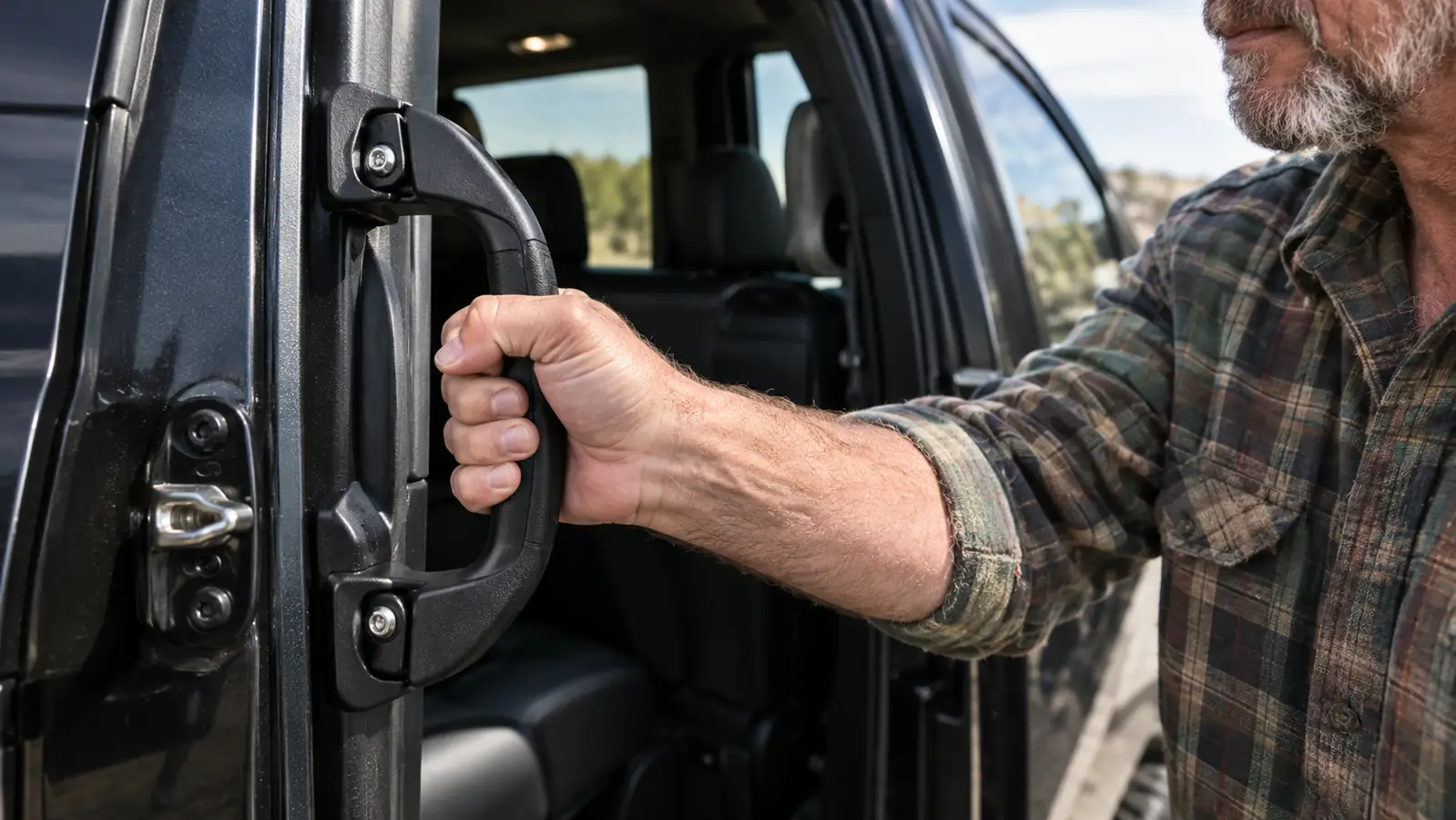
The Stander HandyBar anchors in the door latch and gives you a solid grip at hip height, so you pull with your legs instead of your shoulders. It also carries a window breaker and seat belt cutter, which I hope I never need and am glad is there.
Amazon Check Today's Price on Amazon →Step 1: Set the handle in the latch before you open the door wide
The Stander HandyBar works by sliding its hook into the metal latch where the door locks. That is the part that surprised me: I assumed a handle like this would clamp onto the door frame or hang from the window, and instead it uses the one piece of hardware on the car that is already bolted to the frame. You press the hook into the latch, push the handle down until it seats, and give it one firm tug to confirm it is locked before you put any weight on it.
I install it before I open the door all the way. The latch is easier to reach when the door is mostly closed, and it means the handle is already there when I need it. On my CR-V the latch sits at about hip height, which turns out to be exactly the height I want a handhold. The grip is foam padded and textured, so it does not slip even when my hands are sweaty from the heat. Colorado summers have taught me that a handle is only as good as its grip.
One note from the first week: give the handle a real tug before you trust it. I did not, the first time, and I had a second of doubt halfway through the motion when I was committed and the handle had not yet proven itself. It held. It has held every day since. But the tug is now part of my routine, and it takes one second.
Step 2: Get your feet under you before you pull
The biggest mistake I made with the Stander HandyBar at first was pulling too early. I would grab the handle, lean back, and try to stand while my feet were still tucked under the seat. That is how you end up using your arms and your lower back to do the work, which is exactly what my physical therapist told me to stop doing.
What works instead: slide to the edge of the seat first. Turn your body so both feet are flat on the ground, with your knees bent and your stronger leg, for me the right one, slightly under you. Then put one hand on the handle and the other on the seat or the door frame. From that position, the handle is doing what a grab bar in a shower does: it gives your legs something to push against while your arms stay mostly straight.
On bad days, when my left leg is heavy and my balance feels off, I do this part slowly and I do not skip the feet-first step. It adds about ten seconds. Ten seconds is nothing compared to the cost of a fall, and I have had enough close calls to know the difference.
Step 3: Push with your legs and let the handle steady you
Here is the motion I use: hands in place, feet planted, then a small rock forward and a push through my right leg while my left hand pulls gently on the Stander HandyBar. The handle is not a winch. It does not haul me out of the car. It steadies me and gives my legs something to push against, and that distinction matters. When I use it as a support instead of a lift, my shoulders stay relaxed and my back stays straight.
The height of the CR-V seat means I am never pulling straight up. The handle gives me a diagonal line of support that matches the way my body naturally wants to move, which is the thing I could not get from the steering wheel. The steering wheel is too low and too far away, and it turns when you pull on it. The door frame is too high and too narrow. The Stander HandyBar is the only grip on the car that sits at the height my body actually needs.
Once I am standing, I keep one hand on the handle until both feet are solid and I have found my balance. Then I close the door, remove the handle, and tuck it into the door pocket. That last part matters: a handle left on the latch will swing and mark the paint, and it is one more thing to trip over in the garage.

Step 4: Reverse the whole routine to get in
Getting in is the mirror image, and for me it is actually the harder direction. You sit down first, so you are committing your weight to the seat before your legs are fully under you. With the Stander HandyBar in the latch, I can hold the handle, lower myself onto the seat edge, and then swing my legs in one at a time. My left leg needs the most help, so I lift it with my hand when it will not cooperate.
The key is to sit down facing forward, not sideways. I learned this the hard way. If I sit sideways and then try to rotate, my left hip protests and I end up using the door frame to twist, which is awkward and a little embarrassing in a parking lot. Facing forward, with one hand on the handle, I can control the descent and keep my spine in a neutral position.
Rob and I have a division of labor around this. He lifts the folding transport chair into the back, and I handle the door and the handle. On days when my hands are weak or the fatigue is bad, he stands behind me, not in front, so I can lean back against him if I need to. We worked that out after a parking lot incident involving a curb, a gust of wind, and my pride. The handle does not replace a spotter on a bad day. It just makes the good days independent.
Step 5: Remove the handle and make it part of your routine
The Stander HandyBar takes about two seconds to remove. You push the handle up, tilt the hook out of the latch, and it is free. I keep mine in the door pocket of the CR-V, where it is always in reach and never in the way. It is compact enough that it does not rattle, and the foam grip means it does not scratch anything it touches.
The routine part is the part that actually helped me. The first week, I forgot the handle was there and reached for the steering wheel out of habit. By the second week, my hand went to the handle without me thinking about it. By the end of the month, the motion had replaced the old one, and that is when I noticed my shoulder stopped aching after short trips. The handle did not fix my MS. It removed one small daily battle, and that is not nothing.
I also keep the window breaker and seat belt cutter in mind, because they are built into the base of the handle. I have never needed them. I hope I never do. But the handle is the one thing in my car that would help me get out in an emergency, and for a person with limited mobility, that is a real comfort, not a gadget gimmick.
What Else Helps
A car assist handle works best when the rest of the system is working too. A few things that made the biggest difference for me: a small step stool for the rare times I ride in a taller vehicle, a seat cushion that raises me an inch and makes the seat height closer to my kitchen chair, and a physical therapist who watched me actually get in and out of the car instead of guessing. I also learned to park where the ground is level and the door has room to open fully. A handle cannot help you if you are trying to squeeze out of a half-open door in a crowded lot.
If you are shopping for someone else, the Stander HandyBar is a good first thing to try because it is inexpensive, portable, and works on almost any car with a standard door latch. It is not a replacement for a transfer chair or a lift, and it will not help someone who cannot bear weight on at least one leg. But for the large middle ground of people who can stand with support, it removes the worst part of every car ride. Ask your physical therapist if you are in that middle ground. I was, and I am glad I asked.
The handle did not fix my MS. It removed one small daily battle, and that is not nothing.
Start with the handle, not the whole project
You do not need a new car or a lift to make the SUV easier. The Stander HandyBar installs in the door latch in seconds, works on most vehicles, and costs a fraction of a home modification. Try it on your own car and see if the routine feels different.
Amazon Check Today's Price on Amazon →