
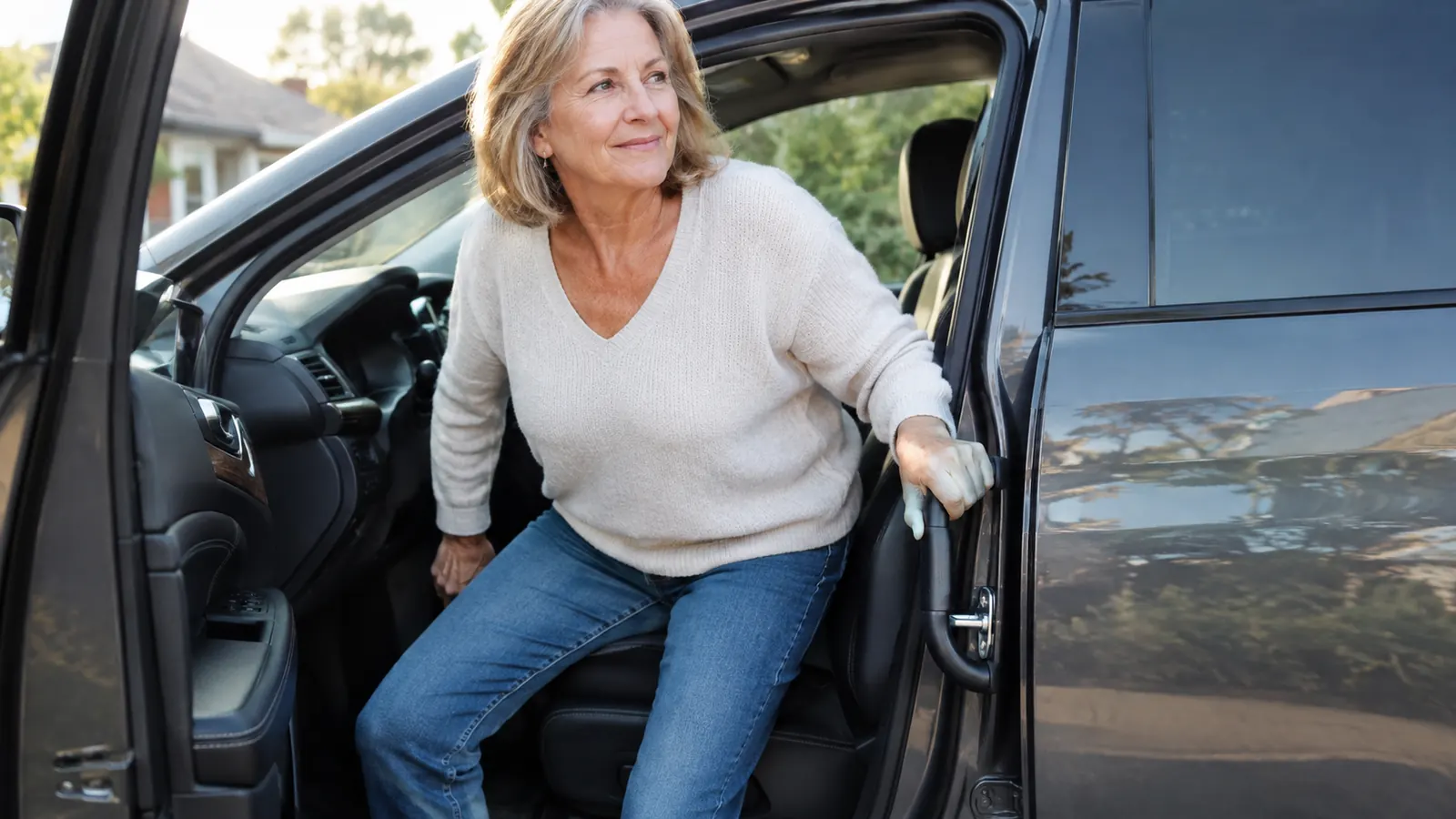
The hardest part of any errand is not the driving. It is the getting out. On a bad day with my left leg, I would sit in the passenger seat of our 2019 Honda CR-V, undo the seat belt, and then stage a small negotiation with the door frame: grip the handle above the window, swing my legs, rock forward, and hope my knee did the thing. Some days it did. Other days I waited for Rob to come around and give me an arm. Then, in late April, I started using the Stander HandyBar, a portable car assist handle that hooks over the door latch pin, and the negotiation mostly went away.
I have now used it through a full Colorado season, which means everything from a cold morning at the pharmacy to a hundred-degree afternoon at the Fort Collins farmers market. This is my honest account of how it held up, what it does not do, and who should probably skip it.
The Quick Verdict
The HandyBar turned the worst two seconds of my day into a non-event. It will not replace a strong arm on a truly bad day, but for daily independence it earns its place in the door.
Amazon Check Today's Price →The handle that made me stop waiting for an arm
After a season of daily use, the Stander HandyBar stays hooked in my door. If your car has a standard latch pin, it may do the same for you. Check today's price on Amazon to see if it fits your vehicle.
Amazon Check Today's Price on Amazon →How I've Used It
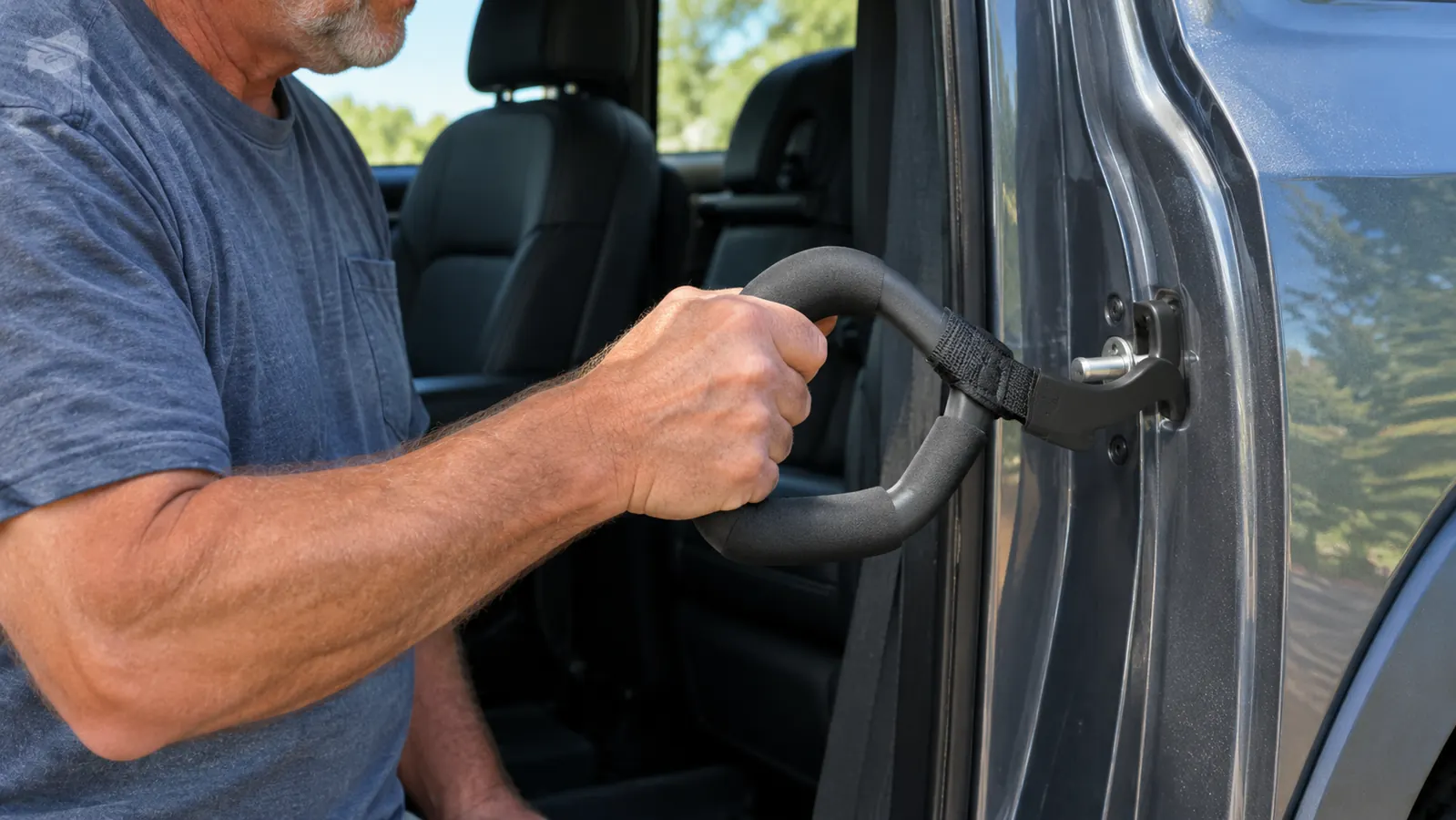
The HandyBar lives in the CR-V, hooked over the latch pin on the passenger door. That is the whole installation: you open the door, slide the curved end over the metal pin where the door latches, and give it a tug to seat it. There is no drilling, no strap, no permanent anything. When I do not need it, it hangs out of the way, and Rob has learned to leave it alone.
I use it every time I get out of the car, which is most days. Mornings are our slowest: Penny needs her walk, I need coffee, and both require getting out of the driveway first. On good days I use the handle as a light assist, more for balance than for pulling. On bad days, when the heat has drained my left leg, I put my weight on it properly and it holds. That is the moment it earns its keep.
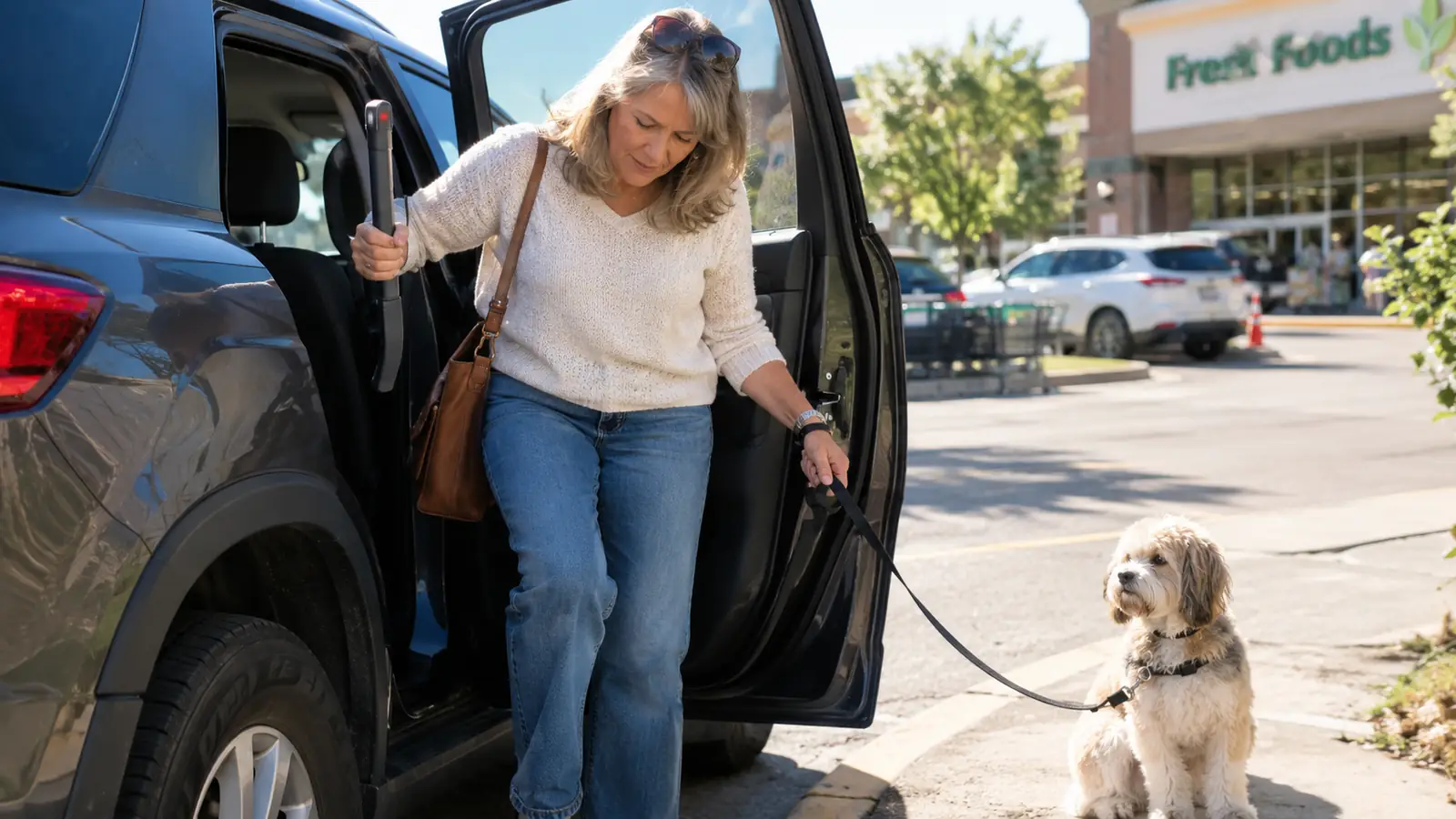
It also travels. We take the CR-V to the zoo, to the farmers market, and to the library where I used to work, and the handle comes along. It takes one second to move from the passenger door to the back door when one of the grandchildren decides they want to ride shotgun. The whole thing weighs almost nothing and fits in the door pocket when I want it out of the way.
What the HandyBar Actually Does
The design is simple: a curved metal hook with a padded grip on top. The hook goes over the door latch pin, the grip faces you, and suddenly you have a solid handle at about hip height, exactly where your hand wants to be when you stand up from a low car seat. The CR-V sits higher than a sedan, which is good for visibility and bad for getting out. The handle bridges that gap.
The grip is the part I notice most. It is a soft, non-slip material with a slight texture, and it does not get slippery in summer heat or when my hands are damp. My hands are not as strong as they used to be, and I never feel like I am going to lose hold of it. The metal underneath feels solid, not flimsy. I have put my full weight on it on bad days, and it has not bent, wobbled, or complained.
The handle also carries two emergency tools: a window breaker and a seat belt cutter, built into the ends of the hook. I will be honest, I have only tested them on the ground, not in an emergency. The seat belt cutter has a small blade that slices through a spare belt I kept from an old car. The window breaker is a pointed tip with a cap over it, and you press it against the corner of the window. I hope I never have to use either one. But knowing they are in the door, within reach of my right hand, has quietly removed a worry I did not realize I was carrying.
One small thing I did not expect: the handle is comfortable for different hand sizes. Rob has large hands and I have smaller ones, and we both use the same grip without adjusting anything. That matters in a household where more than one person rides in the car. It is also quiet, which sounds like a strange thing to praise, but a handle that rattled against the door frame on every bump would have driven me crazy. This one does not.
A Season of Errands: What Improved and What Didn't
Over six months, the thing that improved most was not my leg. It was my mood. Getting out of the car used to take a running start in my head: I would have to decide to do it, brace myself, and then do it before the doubt caught up. With the handle, the decision collapses. I open the door, hook my hand, stand up. It is done before I have time to negotiate with myself.
There was a learning curve, and I will not pretend there was not. The first week, I grabbed the handle too high, near the hook, and it shifted under my hand. The fix was simple: grab the padded grip, not the metal. Also, the handle works best when the door is open to its first stop, not all the way. If the door swings too far, the latch pin moves and the handle sits at a slightly wrong angle. Once I learned to open the door with my left hand and set the handle with my right, it became automatic.
What did not improve: the truly bad days. On the worst days, my left leg simply will not take weight, and no handle changes that. On those days I still call for Rob, and he still comes. The handle has not replaced him. What it has done is reduce the number of days I need him. That is a real thing, and it is worth saying plainly: this is a tool, not a cure.
The heat deserves its own mention. Fort Collins gets hot in July, and heat is the thing that reliably undoes my legs. On a hundred-degree afternoon, my balance gets worse before my strength does, and that is when a handhold matters most. The handle does not care about the temperature. The grip stays put, the metal does not burn through the padding, and I can get out of a hot car without rushing. That was the surprise of the summer: the handle became most valuable exactly when I was at my worst.
The first time I used it, I got out of the car without thinking about the getting out. I had to stop and realize what had just happened.
The Safety Tools: Hope You Never Need Them
The window breaker and seat belt cutter are the features I was most skeptical about. They sound like the kind of thing a manufacturer adds to a spec sheet. But they are not decorative. The seat belt cutter is a real blade, tucked into the end of the handle, and the window breaker is a real point. I practiced with the cutter on a spare belt, and it went through cleanly with one pull.
I have not practiced on a window, because I do not want to replace a car window. The instructions say to press the point into the corner of the glass, and that is what I would do. I will say this: if you buy the handle, take five minutes to read the little card that comes with it. Know which end is which before you need them. On a bad day, you do not want to be reading instructions.
One honest note: these tools are small, and small tools take fine motor control. On a day when my hands are tired, I am not sure I could operate them quickly. That is not a criticism of the product; it is a fact about MS and about my hands. If that is a concern for you, ask your physical therapist about what makes sense for your situation.
Tradeoffs and Annoyances
The biggest limitation is the latch pin. The handle needs a door with a standard latch pin, mounted in the usual place. Most cars have this, but not all. Some trucks and vans have the pin recessed or positioned oddly, and the handle will not seat properly. Before you buy, open your car door and look at the latch. If you can see a metal pin sticking out, the handle will probably work. If you cannot, it probably will not.
The second annoyance is that the handle only helps on the door it is hooked to. It does not help you get into the car, only out of it, and it does not help with the back seat unless you move it. Moving it takes two seconds, so this is a minor thing, but it is worth knowing.
The third is more of a caution: the handle can shift if you grab it wrong. It is not bolted to anything. If you grab the metal hook instead of the grip, or pull sideways instead of up, it will move. It has never come off the pin in six months, but it has shifted, and a shifted handle is worse than no handle because you are already committed to the motion. The fix is the same as the learning curve: grab the grip, pull up, not sideways.
One more thing worth knowing: the handle needs nothing in the way of care. It lives in the door through rain, snow, and the dusty parking lot at the hardware store, and it still looks the same as the day I bought it. I wipe it down when I wash the car, and that is the whole routine.
Alternatives I Considered
Before I settled on the Stander HandyBar, I looked at the other common options. There are handles that strap to the car door frame, which work on more vehicles but take longer to install and leave straps hanging in the door. There are also the handles that mount above the door, the ones you often see in trucks, but those only help if the vehicle already has one, and the CR-V does not.
The thing I liked about the Stander is that it uses the latch pin, which is already there. No drilling, no straps, no permanent change to the car. It is the least invasive option I found, and for a car we plan to keep for years, that mattered. It is also the easiest to move between vehicles, which matters if you ride in more than one car.
At home I have the two steps and the walk-in shower, and I manage. The car was the one place I kept needing an extra hand, and the car is where this handle lives. If you are comparing options, that is the question to ask: where do you actually struggle? Buy for that spot.
What I Liked
- Hooks on in seconds with no tools and no permanent install
- Gives a real handhold at exactly the height you need
- Window breaker and seat belt cutter are always within reach
- Light enough to move between doors or vehicles
- Holds my full weight on bad days without bending
Where It Falls Short
- Only works on doors with a standard latch pin
- Shifts if you grab the metal hook instead of the padded grip
- Does not help you get into the car, only out
- Not a substitute for a second person on the worst days
Who This Is For
This handle is for anyone who rides in a car and finds the getting out harder than the ride. That includes people with arthritis in their hands or hips, people recovering from surgery, people with balance problems, and people whose legs are strong some days and not others. It is also for the family members who shop for those people. If you are reading this because your mother or your spouse struggles with the car, this is a small thing you can do that does not require remodeling the vehicle.
Who Should Skip It
Skip it if you never ride in a car, if your car does not have a usable latch pin, or if you need more than a handhold to get out. The handle is an assist, not a lift. If you need someone to help you stand every time, the handle will not change that, and you should not expect it to. Also skip it if you want something that works on every door of every vehicle, because that is not what this is. It is a tool for one specific job, and it does that job well.
A small handle that bought back a piece of the day
After a season of daily use, the Stander HandyBar stays hooked in my door. If the latch-pin setup fits your vehicle, it may do the same for you. Check the current price on Amazon.
Amazon Check Today's Price on Amazon →