

Some mornings, getting out of our 2019 Honda CR-V is the hardest part of my day. I have relapsing-remitting MS, and my left leg does not always cooperate after a drive. For years I grabbed the basic car door handle, the molded plastic loop that came with the car, and hauled myself up. It worked, sort of. Then a friend let me try her Stander HandyBar, a portable handle that slips over the car's own handle, and the difference surprised me. This is my honest comparison between the Stander HandyBar and the basic car door handle that is already in every vehicle. I am not here to tell you the factory handle is worthless. I am here to tell you what changed for me, and what did not. I have been living with MS for fourteen years, and I know my body's patterns. The worst exits happen after I have been sitting still for forty minutes, which is exactly what a car trip does.
Before I go further, let me be clear about what the basic car door handle is. It is not a product you shop for. It is the factory handle, usually a plastic loop or a molded grip, built into the door. It costs nothing extra, it never needs installing, and it is always there. But it was not designed for someone whose legs are weak and whose balance is unsteady. The Stander HandyBar was designed for exactly that. That difference in purpose shows up in every part of this comparison, from the grip to the angle to the safety tools that ride along in the handle. So if you are shopping for yourself, or for a parent who struggles to get out of the car, this is the comparison I wish someone had shown me. I bought this handle myself, and I have no reason to oversell it. If it did not help, I would tell you.
| Stander HandyBar | Basic Car Door Handle | |
|---|---|---|
| Price | One-time purchase, portable | Already included with the car |
| Grip | Padded, non-slip grip that holds even with a tired or sweaty hand | Hard molded plastic, slippery when your hand is damp |
| Leverage | Lets you push up and outward, using your legs and core | Pulls you across the body, loading the shoulder and lower back |
| Installation | Slips over the existing handle in seconds, no tools | Nothing to install, it is already there |
| Safety tools | Includes a window breaker and seat belt cutter | None |
| Portability | Moves between cars, rentals, or the passenger side | Fixed to this one vehicle |
| Fit | Fits most vehicles, but not every door frame | Always matches this car's door |
| Durability | Well made, but still an accessory | Factory part, built for the life of the car |
How I Compared Them
I tested both options over three weeks, on good days and bad days. On good days, with my cane in the driveway and the car parked on level ground, the basic handle was fine. I could pull myself up with my right arm and swing my left leg out. On bad days, when fatigue made my grip weak, the difference was obvious. The Stander HandyBar gave me a wider, padded surface and a better angle, and I did not have to twist my shoulder to use it. I also paid attention to how I felt after the exit, not just during it. With the factory handle, I often felt a pull in my lower back. With the HandyBar, I felt steadier on my feet once I was standing.
I also tried the HandyBar from the passenger seat, because Rob and I switch seats depending on the errand. It moved from the driver's door to the passenger door in about ten seconds. The basic handle cannot do that. I timed myself getting out with each option on the same stretch of driveway. I am not going to pretend the HandyBar turned me into an athlete, but it cut the hardest part of the exit from a grunt to a normal breath. I also tested it with my rollator in the back seat, which meant I had to get out, then reach back for the rollator without losing my balance. That is where the HandyBar really earned its place.
I also paid attention to how the handle felt in my hand when I was rushed. On the morning I had a doctor's appointment and a short window to get there, I did not have time to think about my exit. I grabbed the HandyBar, pushed up, and was standing before I had finished the thought. With the factory handle, that same rush usually ends with me wincing and my lower back complaining for the rest of the day. That is the kind of difference that does not show up in a spec sheet, but it shows up in how I feel an hour later.
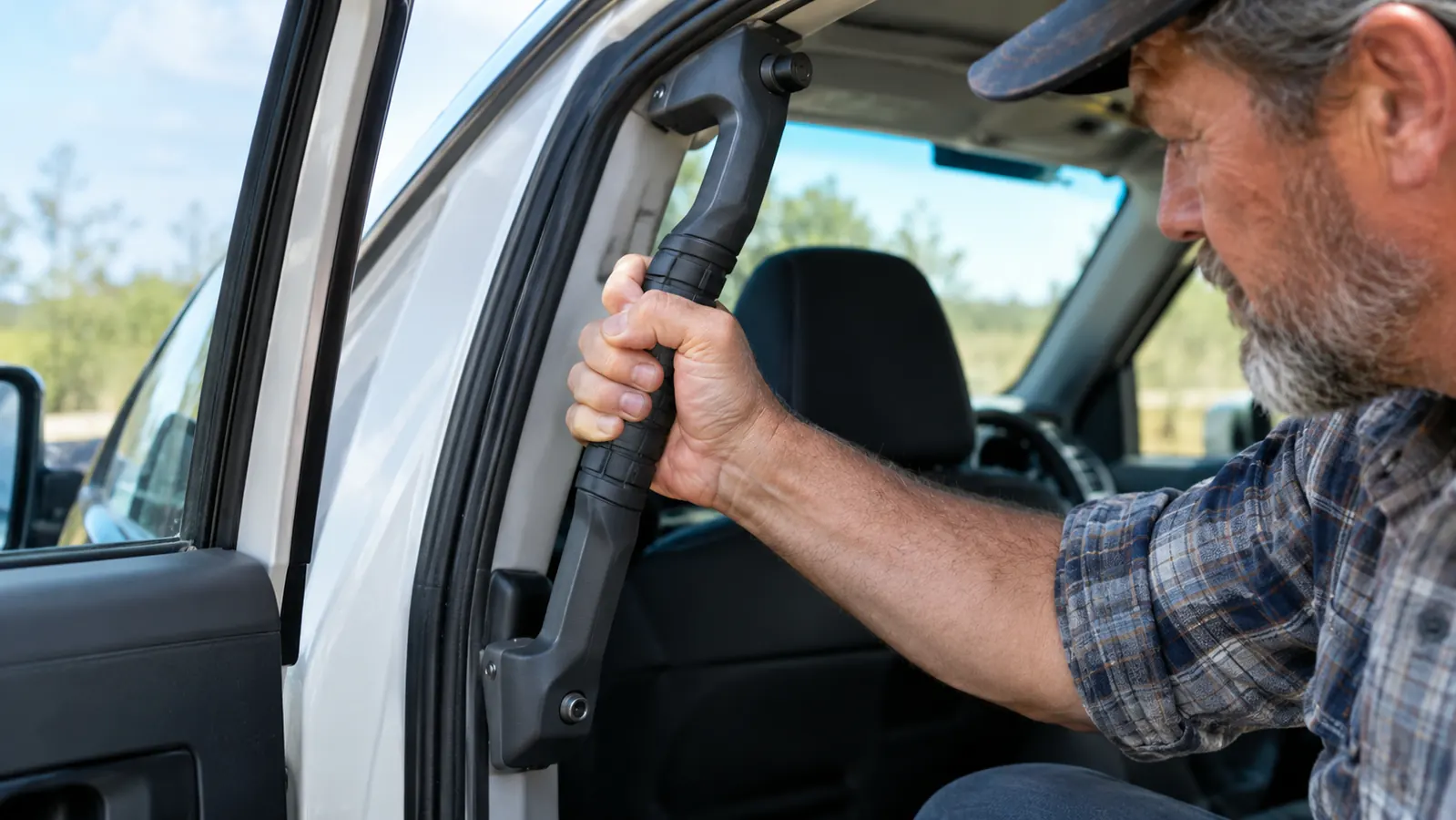
Where Stander HandyBar Wins
The biggest win is grip. The basic handle is a hard plastic loop. When my hands are tired or slightly damp, I have to concentrate to hold it. The Stander HandyBar has a padded, non-slip grip that stays put. That sounds like a small thing until you are half hanging out of a car and your hand starts to slip. For me, that is the difference between getting out with dignity and getting out with a thud. The grip is also wide enough that I can use my whole hand, not just two fingers. On a bad day, that extra contact area is everything. The HandyBar grip is also easier to find in the dark, because it is larger than the factory loop. That may sound minor, but on a winter evening in Fort Collins, it matters.
The second win is leverage. The basic handle pulls you across your body, which loads the shoulder and lower back. The HandyBar is shaped so you push up and outward, letting your legs and core do more of the work. My physical therapist explained it simply: you want to move toward the handle, not away from it. The HandyBar lets me do that. It also includes a window breaker and a seat belt cutter, which I hope I never need, but I like knowing they are there. I keep the HandyBar in the door pocket, so it is always within reach, and I have shown both Rob and my daughter how the safety tools release.
The third win is portability. The basic handle belongs to one car. The HandyBar belongs to me. When Rob and I take a rental car for a longer trip, I bring the HandyBar along. When my daughter drives me to an appointment, I clip it into her door. I have used it in Rob's truck, in my daughter's sedan, and in a rental we took to Denver. It fit all three, though it was snugger in the sedan. That flexibility matters more than I expected. For a longer list of reasons this kind of handle helps, see 10 reasons a car assist handle makes getting out easier. That article covers the everyday moments where a little support changes everything, not just the dramatic ones.
Where the Basic Car Door Handle Wins
I have to be honest: the basic handle wins on price, because it costs nothing extra. It is already in the car, it always fits that car, and it never needs to be remembered, packed, or moved. There is no learning curve. If you have good upper body strength and your car is parked on level ground, the factory handle might be all you need. Plenty of people in my support group have never felt the need for anything else. I am not going to talk you into spending money on a solution you do not need. The factory handle is a perfectly reasonable tool for many people, and it is already paid for. I will also say that the factory handle never lets you down in the way an accessory can. You cannot forget it at home, because it is part of the car.
The basic handle also wins on simplicity and durability. It is a factory part, built for the life of the car. There is nothing to break, nothing to lose, and nothing to install. The Stander HandyBar is well made, but it is still an accessory. You have to remember to move it between cars, and if you drive a vehicle with an unusual door frame, it may not fit as snugly as it does in our CR-V. The fit is not universal. I read reviews from people who said it did not work in their truck or their older sedan. On those points, the factory handle is the safer choice.
The factory handle also wins on one more subtle point: it does not draw attention. Some people feel self-conscious about using mobility aids in public. The Stander HandyBar is fairly discreet, but it is visible when you open the door. The factory handle is invisible because it is just part of the car. If you are not ready for that kind of visibility, or if you are buying this for a parent who resists any kind of assistive device, that is a real consideration. It was not a problem for me, but I have heard from enough readers that I want to be straight about it.
On a bad day, the difference between the factory handle and the Stander HandyBar is the difference between a grunt and a breath.
Get the grip that actually helps you get out
The Stander HandyBar turns the hardest part of a car trip into a simple, supported step. It installs in seconds, includes a window breaker and seat belt cutter, and moves between cars. See today's price on Amazon and read what other users say about the fit and the grip.
Amazon Check Today's Price on Amazon →
Who Should Buy Which
Buy the Stander HandyBar if you have weak grip, shoulder pain, balance trouble, or a vehicle that sits low. Buy it if you travel and want the same support in a rental car, or if you are the passenger and the driver's side handle is out of reach. Buy it if you have good days and bad days, because it is the option that adapts to both. My long-term Stander HandyBar review has more detail on how it held up over months of daily use, including the things that annoyed me, and there were a few. If you are buying for a parent, ask them to try it in the car before you commit. The fit matters more than any spec sheet.
Skip it if you already get out of your car easily with the factory handle, or if you drive a vehicle with an unusual door frame and you are not willing to test the fit. Skip it if you are buying for someone who refuses to use any assistive device, because it will end up in a drawer. And if your mobility issues are mainly about leg strength rather than grip or balance, talk to your physical therapist about whether a handle like this is right for you. I am not a medical professional, and I do not pretend to be one. I can only tell you what worked in my driveway. If you are buying for someone who rides in a van or a shuttle, check the door layout first, because not every vehicle has a handle the HandyBar can grip.
The Bottom Line
Here is my honest bottom line. The basic car door handle is not useless. It is just a tool that was never designed for my body. The Stander HandyBar was designed for exactly that, and the intent shows. On good days, either one works. On bad days, I reach for the HandyBar. If you are shopping for yourself or for a parent, that is the question to ask: which one do you want in your hand on a bad day? For me, the answer was clear enough that the HandyBar now lives in the door pocket of our CR-V, and the factory handle is just the thing I pass on the way to it. And if you are still deciding, that is okay. You can always try the HandyBar and return it if it does not work for you.
Try the Stander HandyBar for yourself
It installs in seconds, moves between cars, and includes a window breaker and seat belt cutter. Check today's price on Amazon and see if the grip works for you before you commit to a long drive.
Amazon Check Today's Price on Amazon →