The hardest part of an outing is rarely the outing itself. It is the energy you spend before you ever reach the door: checking that you can manage the walk, second-guessing the route, bracing for the heat. I have relapsing-remitting MS, and my energy runs out long before my legs do. A rollator changed that math for me. The Drive Medical Aluminum Rollator Walker, with its padded seat and six-inch wheels, has been the difference between staying home and actually going.
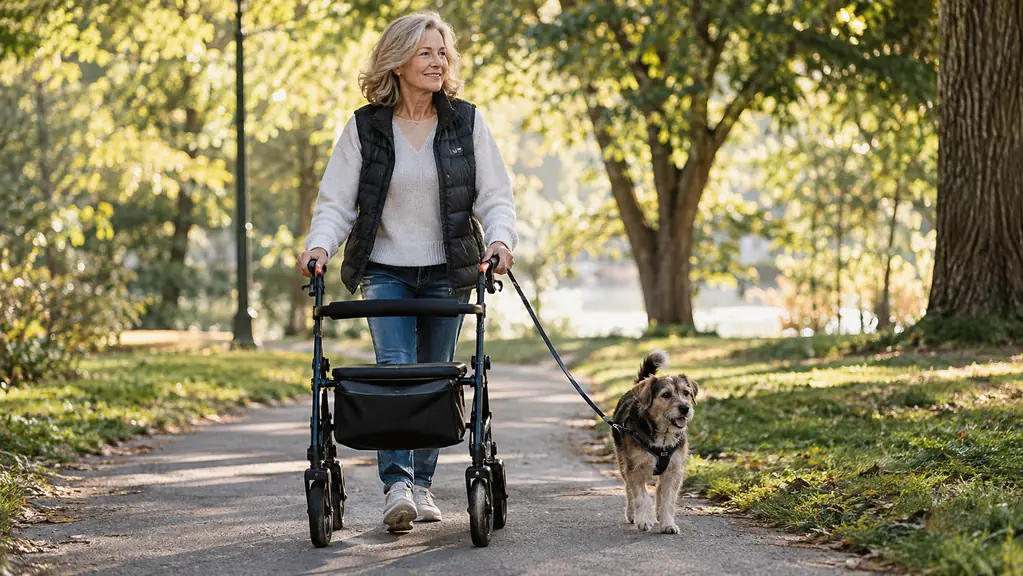
This is not a review of the walker, or at least not only a review. It is a set of habits I have built over hundreds of outings in Fort Collins, with my dog Penny walking slowly beside me and my husband Rob handling the car. Some days I only make it to the end of the block. Other days I cover two miles along the river trail. The difference is rarely my legs. It is how I plan the outing, how I set up the walker, and when I decide to sit down. If you are new to a rollator, or if you have one and it still tires you out, these are the five things that helped me most.
The walker I reach for every morning
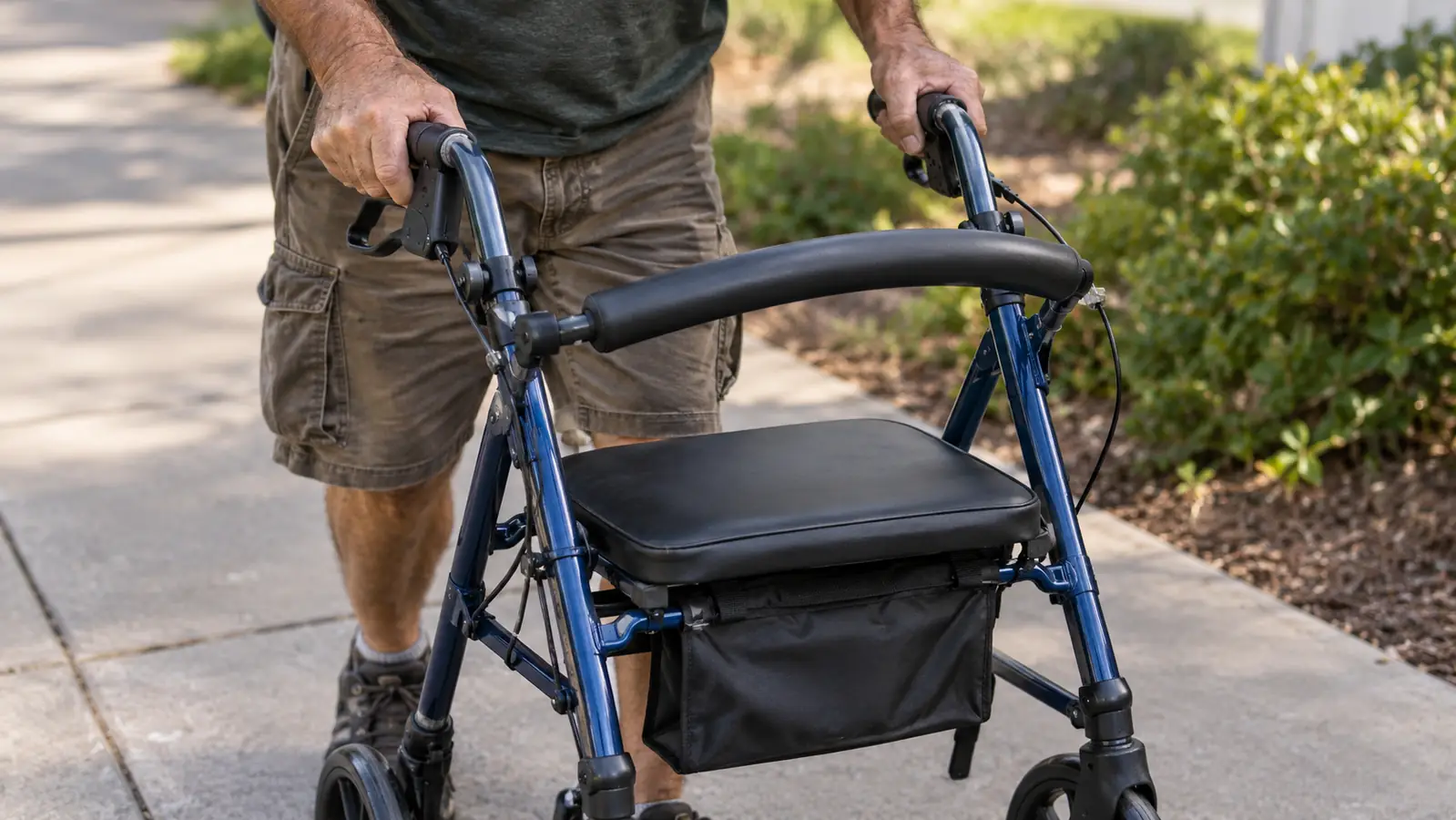
The Drive Medical rollator has a padded seat for rest stops, six-inch wheels that roll over sidewalk cracks instead of catching them, and a frame that folds flat enough for the back of our CR-V. It is the piece of equipment my outings start from.
Amazon Check Today's Price on Amazon →Why I stopped leaving the house on willpower alone
For the first year after my diagnosis, I treated every outing as a test. If I could walk to the end of the block, I told myself, I was fine. If I could not, I stayed home. That test was exhausting, and it was the wrong question. The right question is not whether I can manage an outing on willpower. It is how I can manage the outing so my energy lasts. The rollator is the tool. The habits are the part only I can do.
Step 1: Set the height before you leave, then check it again at the curb
Most of the energy I wasted in my first month came from a walker set at the wrong height. If the handles sit too high, you shrug your shoulders to reach them, and your neck and shoulders are exhausted by the time you reach the mailbox. If they sit too low, you hunch forward, and your lower back pays for it. The Drive Medical rollator has adjustable handles, and the rule I use is simple: stand with your arms relaxed at your sides, then raise your hands to the grips. Your elbows should sit at about a right angle, and your wrists should rest on the grips without you reaching for them.
I set mine in the living room the first time, then checked it again at the curb before our first walk. The two steps up to our front door change my posture for a few minutes, and a height that feels fine indoors can feel wrong once you are on the sidewalk. Adjusting takes seconds. The lever on the frame clicks into place, and there is no tool involved. I do the same check whenever I take the walker out of the car, because folding and unfolding can shift the handles a little.
While you are at it, check the brakes and make sure both wheels are locked before you sit. I learned that on a park bench when the walker rolled a few inches while I was lowering myself. Nothing bad happened, but it taught me to make checking the brakes part of the same routine as checking the height. Two seconds of checking saves a lot of energy later, and it saves a lot of worry too.
Step 2: Push from the frame, not the handles
A rollator is not a shopping cart. It is a walking aid, and the difference matters. When I first started, I gripped the handles hard and pushed the whole walker ahead of me, which meant my arms did most of the work. Now I keep my hands relaxed on the grips and let the frame take my weight. I stand tall, let the wheels roll forward, and my legs set the pace instead of my arms. The walker supports me; it does not get pushed by me.
The six-inch wheels on this Drive Medical model are the reason I can relax my grip at all. Smaller wheels catch on sidewalk cracks and gravel, so you push harder and brace for every bump. Six-inch wheels roll over those cracks, and the aluminum frame stays light enough that the walker glides instead of dragging. On a bad leg day, that is the difference between a mile and half a block. I have tested both, and I know which one I come home from smiling.
Watch your posture as you go. I catch myself leaning on the handles when my left leg gets weak, and leaning puts all the work into my wrists and shoulders. When I notice it, I stand up a little taller, let the frame take the weight through my palms, and keep my elbows soft. It sounds small. It is not small. It is the difference between coming home tired and coming home wiped out, and it is a difference I feel the next morning too.
Step 3: Use the seat as a planned rest stop, not a last resort
The padded seat on the Drive Medical rollator is the feature I use most, and I use it on purpose. Early on, I treated the seat as an emergency option for when I was about to collapse. That was backwards. Now I sit down before I need to, and I sit down on a schedule. On a two-mile walk along the river trail, I stop at the first bench, sit for five minutes, then continue. I come home with energy to spare, and Penny seems to like the breaks as much as I do.
Sitting is also the easiest way to manage heat, and heat is my biggest enemy. MS fatigue gets worse when I overheat, so on warm afternoons I plan a rest stop in the shade halfway through the errand. The seat means I do not need to find a bench. I can stop anywhere the ground is level, lock the brakes, and sit. That turns a hot parking lot into a manageable one, and it turns a long store into two shorter visits with a rest between them.
One safety note: practice getting up from the seat a few times at home before you do it in public. Lock both brakes, slide forward, and push up through your legs. Ask your physical therapist if you are unsure about the motion. It took me three tries to find a rhythm, and now getting up from the seat is as natural as getting up from a chair. Penny sits at my feet while I rest, which is its own kind of therapy.

Step 4: Load light, and keep the weight close to the frame
Everything you hang on a rollator is weight you have to steer. In my first month, I hung my purse from one handle, and the walker pulled to that side the whole way around the grocery store. I was fighting the frame with every step and burning energy without realizing it. The fix was not a different walker. The fix was carrying less and carrying it closer to the center.
Now I carry a small crossbody bag and clip my water bottle to the frame. If I need to carry more, I put the heaviest thing in the seat or in the storage pouch under the seat, as close to the center of the walker as I can get it. The closer the weight sits to the frame, the less it affects your steering. A walker that tracks straight is a walker that saves you energy, and a walker that pulls sideways is a walker that costs you some.
The same rule applies to the car. The Drive Medical folds flat, and Rob lifts it into the back of our 2019 CR-V. I keep a folding transport chair in the back for big days out, like the zoo with our grandchildren, but for everyday errands the rollator is the only thing I need. Less gear in the car means less lifting at the end of the day, and that counts too. Energy saved on the way home is energy I can spend on dinner.
Step 5: Plan the route around shade, benches, and doors
I plan outings the way I used to plan lesson plans: with the hard parts in mind before I leave. Heat is the first consideration. I walk Penny in the morning before the sun gets high, and I run errands early in the day whenever I can. In the summer, the difference between a ten o'clock errand and a two o'clock errand is the difference between a good day and a day spent recovering on the couch.
The second consideration is doors. Automatic doors are worth their weight in gold when your hands are on the grips. I know which stores in Fort Collins have them, and I choose those stores on tired days. When a door is not automatic, I park close, and Rob walks ahead to hold it. That is not a small thing. A heavy door is a wall when you are already using both hands to walk, and a held door can save more energy than any gadget.
Finally, give yourself an out. I always know where the next bench is, where the shade is, and where Rob can pull the car around if I run out of steam. Knowing there is an exit plan means I worry less, and worrying less means I use less energy. The route is the quietest energy saver on this list, because you make most of its decisions before you ever step outside.
What Else Helps
A few smaller things made a real difference, and none of them require buying anything extra. Shoes with good grip matter more than I expected; I wear sturdy walking shoes on outing days and save sandals for the patio. I dress in layers, because a light jacket I can take off is easier to manage than a heavy coat I am stuck in. And I carry water even on short walks, because dehydration hits me twice as hard on a tired day.
I also tell Rob where I am going and roughly when I will be back. That is not about safety, or not only about safety. It is about letting go of the mental load. When someone else knows the plan, I stop carrying it, and that frees energy for the walk itself. If you are buying a rollator for a family member, offer to carry the mental part of the outing. Let them carry the walker.
One more thing: ask your physical therapist about fit. Height, brake tension, and how you transfer from the seat all depend on your body, and a professional can check things I cannot see from here. This article is about how I save energy on my outings. Your plan may look different, and that is fine. The goal is the same either way: more days out, fewer days recovering.
Sitting down before I need to is the single biggest energy saver I have found, and the padded seat is why I can do it anywhere.
The short version of all this: set the walker up right, push it like a walking aid, sit before you need to, carry less, and plan the route. The Drive Medical rollator makes each of those easier, but the habits are what save the energy. Start with the walker, and let the habits follow. That is the order that worked for me.
Start with the walker, then build the habits
The Drive Medical rollator is the base that made these habits possible. Check today's price on Amazon, and if you have questions about fit, ask your physical therapist before you order.
Amazon Check Today's Price on Amazon →